At the IEEE International Reliability Physics Symposium 2025, imec announced a significant breakthrough in the stability of GaN MISHEMTs (Metal-Insulator-Semiconductor High Electron Mobility Transistors) for RF power amplifiers. Despite challenges with positive bias (on-state) instability, imec's research demonstrates that GaN MISHEMTs maintain consistent performance within a well-defined operating range, paving the way for reliable 5G+/6G communication systems.
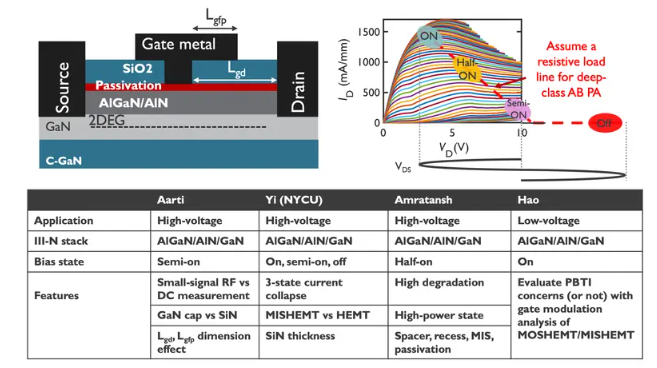
Figure: (Top left) Schematic of the MISHEMTdevice, and (Top right) critical stress states during power amplifier operation. (Bottom) Comparison of the 4 analysis of papers presented at the 2025 IEEE IRPS conference from imec's advanced RF program in collaboration with Prof. Tian-Li Wu's team in NYCU in Taiwan.
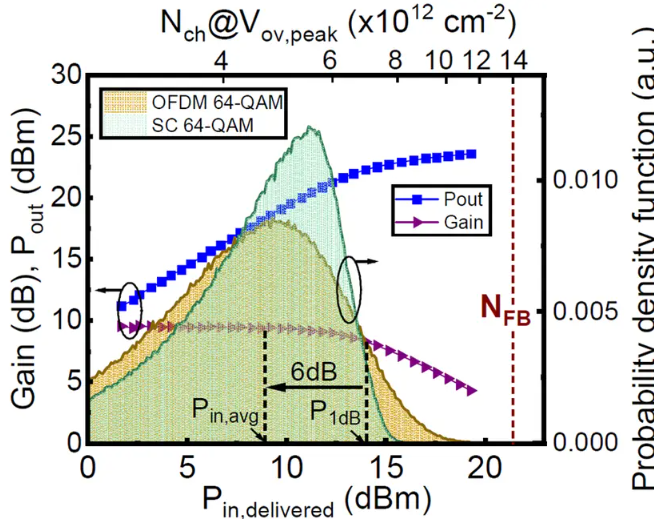
Figure: Simulated probability profiles indicating the operational range of a power amplifier. The region where channel electron density Nch remains below the flat-band threshold NFB represents the safe operating range of a MISHEMT PA without on-state Vth instability concern.
GaN MISHEMTs are highly efficient and capable of handling significant power, making them ideal for 5G+/6G RF systems. However, these devices have faced issues with positive gate bias instability (ΔVth), where shifts in the threshold voltage can impact performance and long-term reliability. This instability can occur in various operational states—off, semi-on, and on—each with distinct mechanisms. Traditional RF power amplifiers typically use GaAs HBT or HEMTs without a dielectric gate, making this a relatively unexplored area.
Imec researchers have introduced a pragmatic analytical approach that compares stable gate voltage ranges in DC conditions with actual gate modulation ranges in RF power amplifier operation. Their analysis reveals a strong overlap between these ranges, confirming that GaN MISHEMTs remain stable within the typical voltage swing of RF power amplifiers. This allows for the design of linearly operating power amplifiers that avoid ΔVth concerns.
“Our research goes beyond identifying challenges. It offers practical solutions, demonstrating that GaN MISHEMTs can be reliably used in power amplifier applications for 5G+/6G technology. By integrating fundamental device reliability research with real-world RF system assessments, our team at imec is bridging the gap between theoretical studies and practical applications, ensuring that GaN technology can meet the demands of next-generation communication systems,” says Hao Yu, Principal Member of the Technical Staff at imec.
The research also highlights the role of naturally occurring positive interfacial polarization charges at the material interface in preventing unwanted shifts in operating voltage over time. This unique feature makes GaN MISHEMTs more immune to on-state threshold voltage (Vth) instability compared to other gate dielectric devices, such as MISFETs. Simulations further demonstrate that even under real-world RF input signals, on-state Vth instability is mitigated. These insights provide crucial guidance for designing robust, high-performance power amplifiers.
The findings were presented as a highlight at the 2025 IEEE IRPS conference, alongside three complementary papers from imec's advanced RF program in collaboration with Prof. Tian-Li Wu’s team at National Yang Ming Chiao Tung University in Taiwan. These papers explore different degradation mechanisms and reliability challenges of GaN HEMTs and MISHEMTs under various stress conditions, contributing to a comprehensive understanding of GaN-Si device performance.
"We are very glad to work on the reliability evaluation and degradation analysis in RF GaN MISHEMTs with imec since reliability is the key bottleneck toward successful commercialization. Through this collaboration, we are able to address industry challenges while cultivating talent for advanced semiconductor R&D,” says Dr. Tian-Li Wu, Professor at National Yang Ming Chiao Tung University in Taiwan.