
The Korea Institute of Machinery and Materials (KIMM) has developed a 15 kW Turbo-Brayton cryogenic chiller for semiconductor manufacturing that cools to −120°C or below using nitrogen refrigerant with a global warming potential (GWP) of zero.
As semiconductor devices become more integrated, etching processes used to create deep and precise patterns require cooling fluids around −100°C to remove heat generated during manufacturing. KIMM said conventional vapor-compression chillers often use refrigerants with high GWP and face technical limitations in increasing cooling capacity.

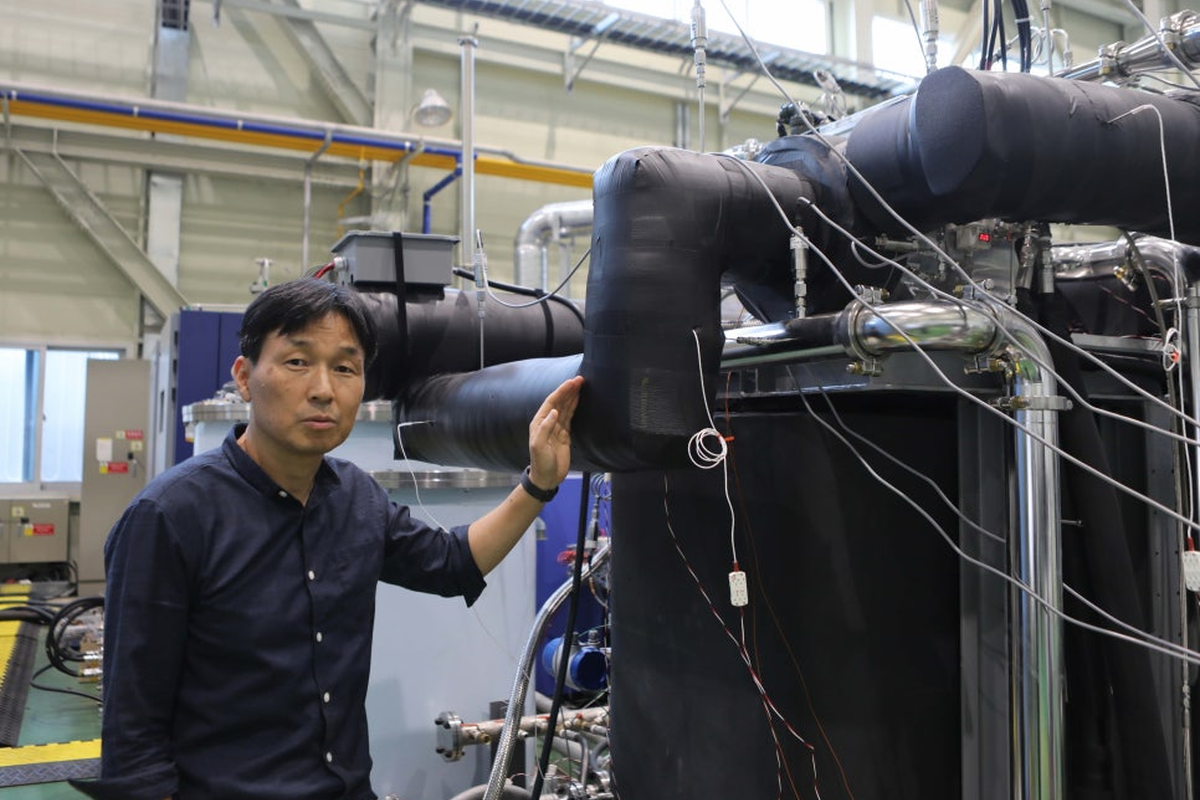
The system uses the Turbo-Brayton cycle, which produces a cooling effect by compressing and expanding nitrogen gas. KIMM designed it to operate at pressures of 10 atmospheres or less. Its turbomachinery uses magnetic bearings to support the rotating shaft without lubricating oil and runs at 60,000 revolutions per minute (rpm); the oil-free design addresses the risk that lubricating oil could freeze at cryogenic temperatures.
The industrial chiller measures 1.6 m wide, 1.6 m deep, and 2.1 m high. In performance tests, it reached −120°C or below within 30 minutes of startup and operated under its target cooling load of 15 kW within 60 minutes. At rated operating conditions, it consumed 90 kW of electrical power and achieved a coefficient of performance (COP) of 0.167, the ratio of cooling capacity to power consumption.
KIMM said the system is the first large-capacity Turbo-Brayton cryogenic chiller developed in Korea to a commercialization-ready level, with operating performance verified. The work advances the team's 2024 demonstration of cooling performance exceeding 10 kW at −100°C.
The technology has been transferred to CHAGO ENGINEERING Co., Ltd., a Korean semiconductor chiller manufacturer, which is targeting a product launch in 2027. KIMM said the chiller could be used in semiconductor etching equipment and other industries requiring large-capacity cryogenic cooling.