
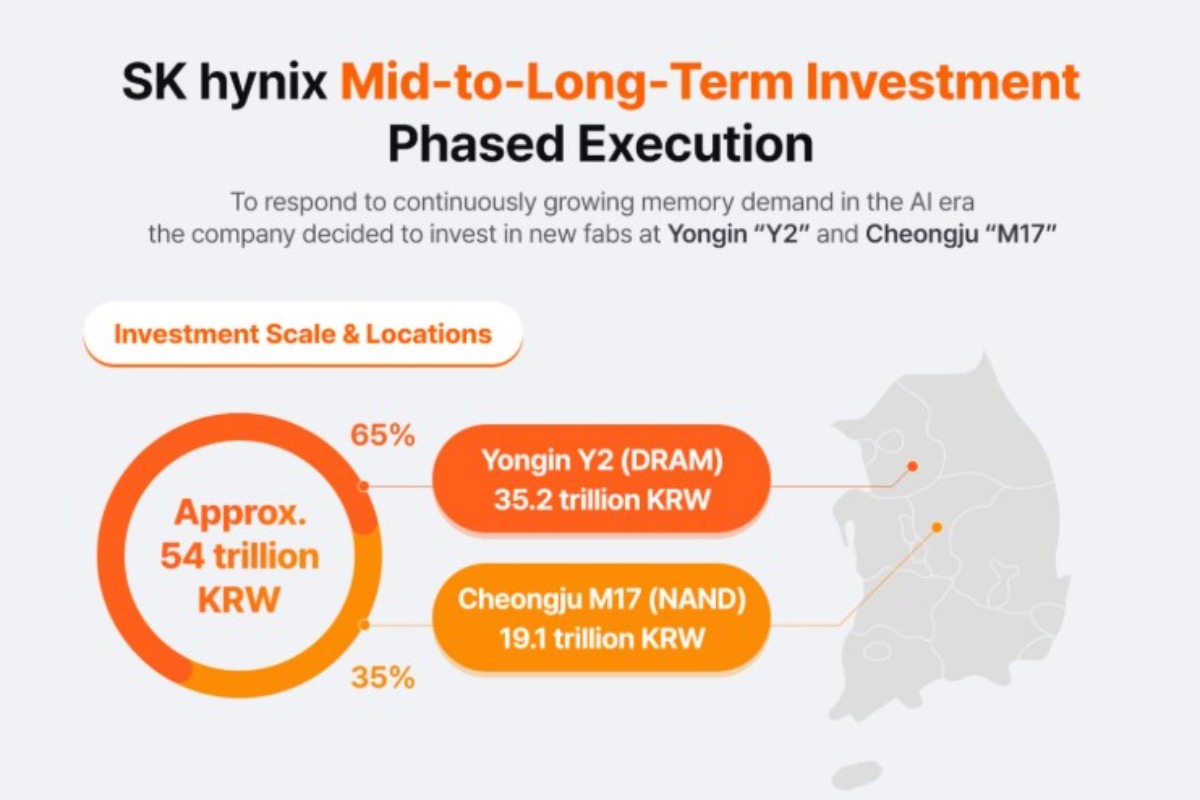
SK hynix has decided to build two new semiconductor fabrication plants, one in Yongin and one in Cheongju, in response to continuously growing memory demand tied to AI. The company's board approved a combined investment of roughly 54 trillion won, split between 35.2 trillion won for the Yongin "Y2" fab and 19.1 trillion won for the Cheongju "M17" fab.
This move follows through on the mid-to-long-term investment plan SK hynix announced last June, under which it committed to investing 600 trillion won in its Yongin Semiconductor Cluster and 100 trillion won to expand its Cheongju production base. The company is already building its first Yongin fab, known as Y1, and this latest decision moves construction forward on subsequent facilities in both locations.
According to market research firm Omdia, demand for both DRAM and NAND memory is projected to grow at a compound annual rate of 19% from last year through 2030. SK hynix says it views this not as a temporary spike in demand but as a more permanent structural shift, in which memory chips are becoming core infrastructure that determines AI performance itself, rather than just another component. The company said that in the AI era, technological competitiveness alone isn't enough; being able to supply the exact volume customers need at the exact time they need it has become the real competitive advantage, and that this investment decision followed a thorough review of market demand.
Yongin Y2 is the second of four fabs planned for the Yongin Semiconductor Cluster, and will serve as a DRAM production facility spanning roughly 1,130,000 square meters. Construction is scheduled to break ground in July of next year, with the goal of opening its first cleanroom in June 2029 to produce high-bandwidth memory (HBM) and other next-generation DRAM products. Meanwhile, construction on Y1 is on track toward its own cleanroom opening target of February next year.
ADVERTISEMENT
SK hynix had previously set a goal of finishing the entire Yongin Semiconductor Cluster, all four planned fabs, twelve years earlier than originally scheduled, moving the completion date from 2045 up to 2033. The Y2 fab represents the second phase supporting that accelerated timeline, with its investment period running through October 2031. The total investment also covers a business support building with administrative and welfare facilities for Y2 staff, an integrated R&D center to consolidate product development, testing, and analysis work, and supporting infrastructure such as water treatment facilities, underground utility conduits, substations, and warehouses.
At the broader Yongin Semiconductor Cluster site, which spans roughly 4,160,000 square meters in Wonsam-myeon, Cheoin-gu, Yongin-si, the first phase of power and water infrastructure needed to support operations through Y2 is nearly complete, currently at 99% progress. Since fab construction and infrastructure buildout have been happening in parallel, the company expects Y2 construction to proceed on schedule.
On the NAND side, demand is rising quickly, driven mainly by enterprise SSDs as AI services continue expanding at scale. That demand is further boosted by the need for storage supporting key-value (KV) cache, a technique used in AI inference that stores and reuses previously computed data to avoid redundant calculations, with SK hynix expecting demand to broaden further as agentic and physical AI applications become more common.
ADVERTISEMENT
SK hynix chose Cheongju as the site for its new NAND fab because it offers the fastest possible construction timeline. The Cheongju campus already hosts the M11, M12, and M15 fabs, allowing the new facility to tie into existing operations at a site that already has substantial power and water infrastructure in place. The new M17 fab will span roughly 680,000 square meters, with groundbreaking planned for February next year and its first cleanroom expected to open in December 2028; the investment period for this fab runs through April 2031.
SK hynix says it plans to proactively build out production infrastructure based on mid-to-long-term demand discussions with customers, while scaling actual production capacity to match when customers actually need it. Fabs themselves will be built according to the master schedule, while cleanroom expansions and equipment installation will happen incrementally in line with demand trends, aimed at maximizing capital efficiency.
The company expects this investment to secure its future growth while strengthening the broader domestic semiconductor industry and boosting local economies. It anticipates that these large, simultaneous investments in Yongin and Cheongju will create growth opportunities for supply chain partners, generate jobs, and help revitalize local commercial areas, contributing to the broader national economy.
An SK hynix official said the investment reflects a decision to seize opportunities in step with the market's pace of growth, and that by proactively securing production capacity, the company aims to position itself as a key partner in AI infrastructure and contribute to the stability of the global AI semiconductor supply chain.