

TDK Corporation has expanded its µPOL family of non-isolated DC-DC power modules with the introduction of the FS1525.
The FS1525 is a point-of-load (PoL) converter with a height of 3.82 mm that delivers up to 25 A per module. Multiple FS1525 modules can be stacked or paralleled to provide a combined output of up to 200 A in vertical power delivery designs, where the PoL converters are positioned directly under the FPGA, SoC, or ASIC on the backside of the PCB.
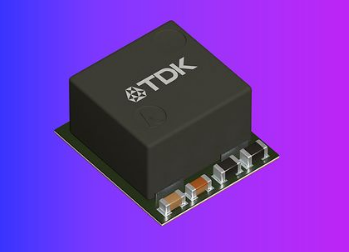
The module measures 7.65 mm × 6.80 mm (L × W) and integrates the controller, driver, MOSFETs, digital core, memory banks, bypass capacitors, and power inductor into a single component using 3D chip-embedded package technology. It features a thermally enhanced architecture with a thermal impedance of 1.4 K/W.

The FS1525 supports input voltages from 4.5 V to 16 V and an adjustable output voltage range from 0.6 V to 1.8 V. It is designed for low-voltage AI processors, including core voltages of 3-nm to 6-nm ASICs and SERDES rails, achieving sub-5 mV peak-to-peak ripple. The module provides ultra-fast transient response, ultra-low DC ripple, and low spectral noise, making it suitable for DSPs, imaging, and advanced Automated Test Equipment (ATE) applications.
It incorporates true differential remote sensing for accurate voltage regulation at the point of load. Digital programmability is available through I²C and PMBus interfaces, enabling real-time telemetry, adaptive tuning, and fault management for voltage, current, and temperature monitoring. The module also supports analog Vout settings compatible with leading FPGA/SoCs and ASICs, including Altera’s SmartVID feature for the Agilex FPGA series.
The FS1525 integrates with computing form factors such as PCIe, VPX, SMARC, and 1U to 3U rack systems. It has been deployed in designs for Altera Agilex, AMD Versal Edge, AMD-Xilinx Zynq UltraScale+ MPSoC, and Versal ACAP platforms, which are used in AI and machine learning applications.
As part of TDK’s µPOL portfolio covering 1 A to 200 A, the FS1525 offers active current sharing and interleaved operation up to 16 MHz for scalability beyond 200 A. It requires no external compensation, supports pre-bias output, and includes multi-time programmable (MTP) storage for custom configurations.
The operating temperature range is -40°C to +125°C. Evaluation boards are available for 25 A and 50 A configurations from DigiKey and Mouser, with stackable boards for 100 A and 200 A available upon request.
Design collateral includes FS1525 starter schematics and PCB layouts at Ultra Librarian, SIMPLIS models, and PDN libraries for top FPGAs/SoCs accessible via TDK’s website.