
NoMIS Power has announced a significant breakthrough in its next-generation 1.2 kV planar SiC MOSFET platform. The new devices achieve substantial reductions in on-resistance by optimizing device design and process steps, making it easier than ever to integrate SiC into legacy systems or push the boundaries of new power converter designs.
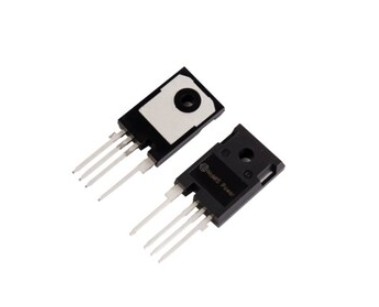
In less than eight months since its last product release, NoMIS Power has delivered a remarkable performance leap in its 1.2 kV planar SiC MOSFETs, achieving a specific on-resistance (Ron,sp) of 2.5 mΩ-cm² at room temperature with a gate oxide thickness of 50 nm. This combination of low Ron,sp and a thicker-than-industry-standard gate oxide enables NoMIS' next-generation devices to support higher-frequency switching with reduced input capacitance and enhanced reliability margins, due to the lower electric field stress on the gate oxide.

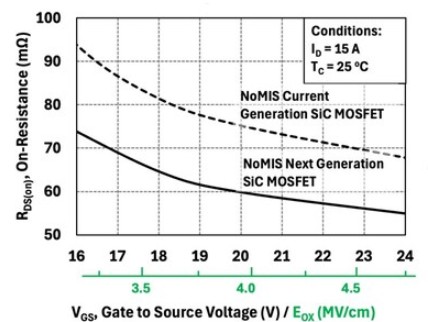
These new SiC MOSFETs deliver up to a 20% reduction in Ron,sp compared to the previous generation, while being fabricated using the same underlying process baseline. This results in a direct performance upgrade that empowers system designers to extract more efficiency and power density from existing footprints.
NoMIS Power's breakthrough also allows engineers to operate gate drivers at either +18 V or +20 V gate-to-source voltage (Vgs) with near-identical performance, eliminating the penalty associated with lower Vgs operation. As a result, NoMIS SiC MOSFETs simplify integration into legacy power electronics platforms while accelerating the transition to SiC.
"These new planar SiC MOSFETs push us further ahead of the curve," said Dr. Seung Yup Jang, VP Head of SiC Device Development at NoMIS Power. "We're not just improving benchmarks—we're removing barriers to SiC adoption by giving system designers more flexibility, better performance, and greater confidence.