
National Supercomputing Mission (NSM), a flagship initiative launched in 2015 by the Government of India, continues to advance the nation’s high-performance computing (HPC) capabilities. Aimed at fostering self-reliance in supercomputing, the mission has deployed 34 supercomputers with a combined compute capacity of 35 Petaflops across institutions like IISc, IITs, and C-DAC, including Tier-II and Tier-III cities, as of March 2025.
The NSM has facilitated over 10,000 researchers, including 1,700 PhD scholars, completing more than 1 crore compute jobs and publishing over 1,500 papers in leading journals. The supercomputers, achieving over 85% utilization, support critical domains such as drug discovery, disaster management, energy security, and material research. Access is provided through the National Knowledge Network, connecting academic and R&D institutions.
The NSM has facilitated over 10,000 researchers, including 1,700 PhD scholars, completing more than 1 crore compute jobs and publishing over 1,500 papers in leading journals. The supercomputers, achieving over 85% utilization, support critical domains such as drug discovery, disaster management, energy security, and material research. Access is provided through the National Knowledge Network, connecting academic and R&D institutions.
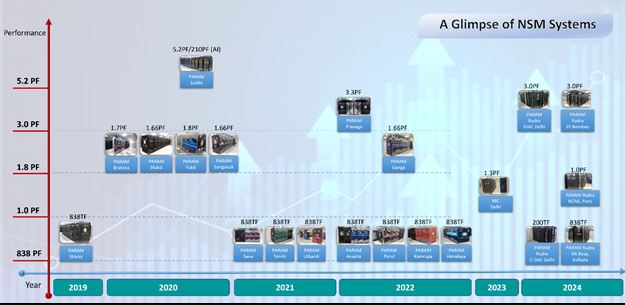
The mission has progressed through three phases: Phase 1 focused on assembling supercomputers domestically, Phase 2 advanced indigenous manufacturing with a 40% value addition, and Phase 3 emphasizes full indigenization of design and production. Notable systems include Param Shivay (2019) at IIT-BHU, Param Pravega (2022) at IISc with 3.3 Petaflops, and three Param Rudra supercomputers (2024) in Pune, Delhi, and Kolkata, built with indigenously designed Rudra servers and software. C-DAC’s Trinetra network, with Trinetra-A (100 Gbps) deployed and Trinetra-B (200 Gbps) planned, enhances data transfer.
ADVERTISEMENT

The India Semiconductor Mission (ISM) supports NSM by developing domestic processors, memory chips, and accelerators, reducing reliance on imports and enabling faster, cost-effective, and tailored supercomputers. NSM plans to expand with 45 Petaflops of additional infrastructure in 2024-25, including a 20 Petaflop system at C-DAC Bangalore. With ₹1,874 crore allocated, the mission, steered by DST, MeitY, C-DAC, and IISc, aims to position India as a global supercomputing leader.
ADVERTISEMENT

Pic and news source: PIB