
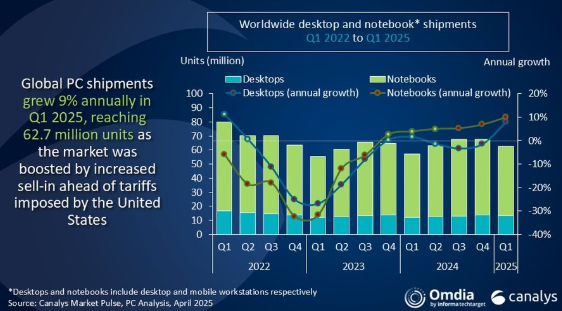
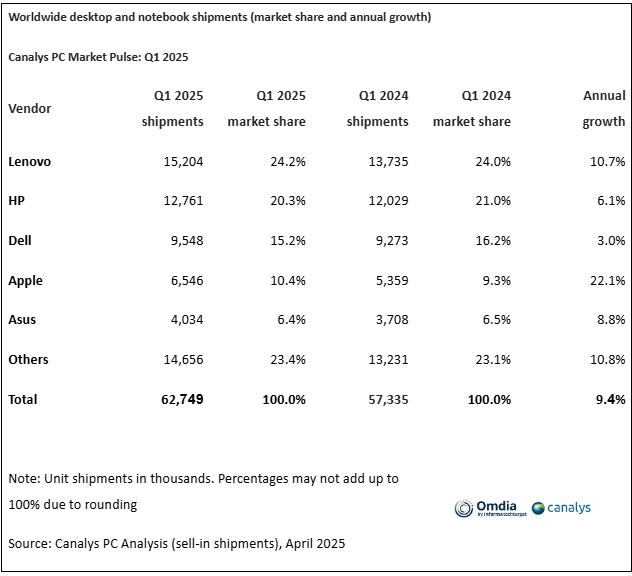
According to the latest data from Canalys, now part of Omdia, worldwide shipments of desktops, notebooks, and workstations grew by 9.4% year-on-year, reaching 62.7 million units in Q1 2025. This growth was driven by a significant increase in notebook shipments, which rose by 10% to 49.4 million units, while desktop shipments increased by 8% to 13.3 million units.
“PC shipments experienced a surge in Q1 2025, driven by vendors accelerating deliveries to the US in anticipation of initial tariff announcements,” said Ishan Dutt, Principal Analyst at Canalys, now part of Omdia. Lenovo and HP grew shipments to the US in Q1 by around 20% and 13%, respectively. “This preemptive strategy allowed manufacturers and the channel to stock up ahead of potential cost increases, boosting sell-in shipments despite otherwise stable end-user demand,” added Dutt. “Although similar steps are being taken regarding the broader tariffs set to kick in on 9 April 2025, subsequent quarters this year are likely to see a slowdown as inventory levels normalize and customers face higher prices.”
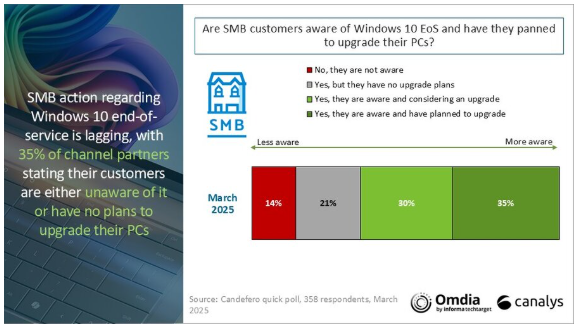
The impact of tariffs on consumer demand is expected to be greater, as purchasing a more expensive PC will need to be prioritized against other spending categories also facing price increases. Businesses, especially SMBs, will also face some pressure that could slow down momentum for the critical transition away from Windows 10 ahead of the October 2025 End-of-Support (EOS) date. “A Canalys (now part of Omdia) March poll of channel partners who are familiar with SMB PC refresh plans revealed that 14% say their customers are not aware of Windows 10 EoS and a further 21% say their customers are aware but have no plans to upgrade,” said Dutt. “For customers in these situations, the delay in planning means they are likely to face a higher cost environment when the time comes to refresh their PC fleets.”

Lenovo and HP were among the top performers, with Lenovo growing its shipments to the US by around 20% and HP by 13%. However, the next round of higher tariffs on more countries is expected to impact the market, potentially slowing down the momentum for the remainder of the year.
“The impact of tariffs on consumer demand is expected to be greater, as purchasing a more expensive PC will need to be prioritized against other spending categories also facing price increases,” added Dutt. “Businesses, especially SMBs, will also face some pressure that could slow down momentum for the critical transition away from Windows 10 ahead of the October 2025 End-of-Support date.”
From a production perspective, major OEMs have already begun diversifying their supply chains, moving away from China towards Vietnam, Thailand, and India. Despite these countries also facing tariffs, their rates remain relatively competitive compared to China’s. By the end of 2025, most major PC vendors are expected to have completed the shift of US-bound shipments out of China, enhancing supply chain resilience and mitigating the impact of tariffs.
In their latest earnings call, HP CEO Enrique Lores stated that 90% of the company’s products sold in the US would be made outside of China by the end of this year. “Although these major manufacturing countries have been targeted with tariffs, their rates remain relatively competitive compared to China’s,” said Ben Yeh, Senior Analyst at Canalys, now part of Omdia. “Moreover, these countries have shown a willingness to negotiate, raising the possibility that the tariffs may eventually be reduced or waived.”
In Q1 2025, Lenovo maintained its lead in the global PC market, shipping 15.2 million units and achieving strong growth of 10.7%. HP followed with 12.8 million units shipped, growing 6.1% annually. Dell saw a modest growth of 3%, shipping 9.5 million units. Apple secured fourth place with a significant 22.1% growth, shipping 6.5 million units. Asus rounded out the top five with 8.8% growth, shipping 4.0 million units.