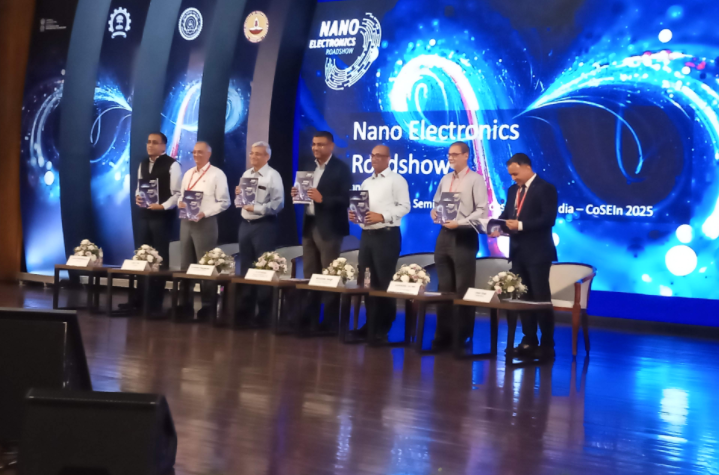

There is significant patentable and patented innovations happening at IITs and IISc. The event "Nano Electronics Roadshow" held at IISc on 27th Mar 2025 was a platform for researchers from these institutes to connect to commercial world including venture capitlists. That purpose was well served along with talks from senior people in the government, industry and academia. The Roadshow was inaugurated by S Krishnan, Secretary, MeitY, along with Abhishek Singh, Addl. Secretary, MeitY.The roadshow included 48 technology demonstrations by students from the Nano Centers, alongside discussions on industry challenges.
The event, organized by MeitY in collaboration with IISc and several Indian Institutes of Technology (IITs), including IIT Bombay, IIT Madras, IIT Delhi, IIT Kharagpur, and IIT Guwahati, marked India’s first Nano Electronics Roadshow. It featured over 100 intellectual properties (IPs) and more than 50 technologies showcased by seven academic institutions, alongside contributions from 35 startups.

Krishnan emphasized the role of MeitY’s Nano Centers, established at IISc and IITs, in advancing research and workforce development. He noted that these centers aim to prepare 85,000 professionals for the semiconductor industry. “With nearly 70%-75% of investments in major semiconductor facilities funded by taxpayers, every Indian has a stake in the India Semiconductor Mission,” he stated, adding that 20% of the global semiconductor design workforce is based in India.
Industry perspectives were shared by Utpal Shah, Senior Vice President of Tata Electronics, and Anand Ramamoorthy, Managing Director of Micron India. Shah highlighted the need for venture capital to support fabless startups under the government’s Design Linked Incentive (DLI) scheme, while Ramamoorthy pointed to the challenges semiconductor startups face in securing funding and aligning innovations with market needs. Tata Electronics is developing India’s first 12-inch semiconductor fab in Gujarat, targeting 50,000 wafers per month, with operations supported by collaborations with IITs and IISc.
India’s semiconductor sector is set to expand, with plans for five fabrication plants over the next decade, requiring approximately 100,000 skilled workers. Despite this growth, Krishnan noted that domestic production will meet only a fraction of the projected $100 billion demand by 2030, underscoring the need for continued investment and collaboration across government, industry, and academia.