
Energy conservation focused semiconductor chip maker e-peas and Silabs have jointly made availabe video of e-peas’ and Silabs new Explorer Kit, where the two companies showed how smart-building, asset tracking and factory automation device OEMs, can simply and cost-effectively develop battery-less Ambient IoT systems. They are working toward developing electronics solutions using energy harvesting or to make batteries last very longer with a motto of “batteries need to live longer than the IoT devices they power.”
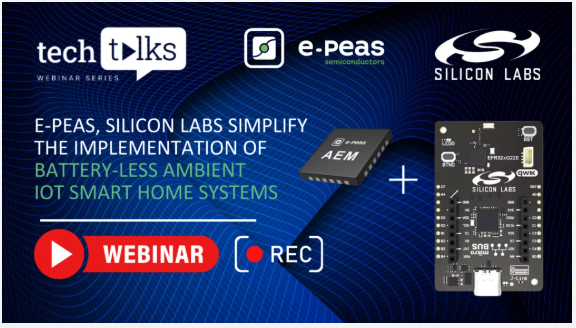
In this video e-peas’ dual source energy harvesting IC solution AEM13920 and AEM00300, an integrated energy management circuit are used within Silicon Labs new Explorer Kit (featuring EFR32xMG22e) with an ultra-fast cold start and highly energy-efficient deep sleep mode.
The webinar is a full walk-through guide for developers, with demonstrations, best-practice guides, and system-level efficiency insights. Registered viewers will also get access to a GitHub software and documentation repository to simplify and speed up the design of battery-free, self-sustaining IoT devices.
“The need for OEMs to move away from batteries to the Ambient IoT is becoming urgent,” said Bruno Damien, Ecosystem Marketing Director at e-peas. “Consumers and facility managers are becoming acutely aware of the cost of maintaining these devices and the environmental impact of discarded batteries, too. But there is a knowledge gap when it comes to implementation, and we’re delighted to have partnered with Silicon Labs to help address this.”
The AEM13920 shield has been designed to manage power from multiple continuous and intermittent sources, including photovoltaic, thermal, RF, inductive, and piezoelectric systems. It delivers a 90% energy-transfer efficiency and is compatible with powering Bluetooth, Zigbee, and custom protocols from Silicon Labs. Additionally, it implements a programmable output voltage. Storage elements associated with the kit can store up to 1,000 J for a more stable and reliable power supply.
The AEM00300 shield has been designed to cope with random pulsed energy of just a few hundred microjoules without compromising energy efficiency. To achieve this, it builds on a smart architecture that has been designed to store this unpredictable pulse of energy to give a stabilized delivery to the application.
The presentation also used multi-protocol IoT solutions from Silicon Labs.
To watch ‘Harvesting Energy for Smarter IoT” Tech Talk visit: