
Ambiq Micro, Inc. has announced that Tapestry OS’s open-source coordination software now runs on its Apollo510 and Apollo330M Plus systems-on-chip (SoCs), enabling battery-powered sensors and robots to coordinate locally without a central controller or cloud connection.
Physical AI applications in robotics and industrial sensing require devices to sense their surroundings, process information and respond to changing conditions. When devices work together, manufacturers must also manage communication, shared information and group behavior within the system’s energy budget.

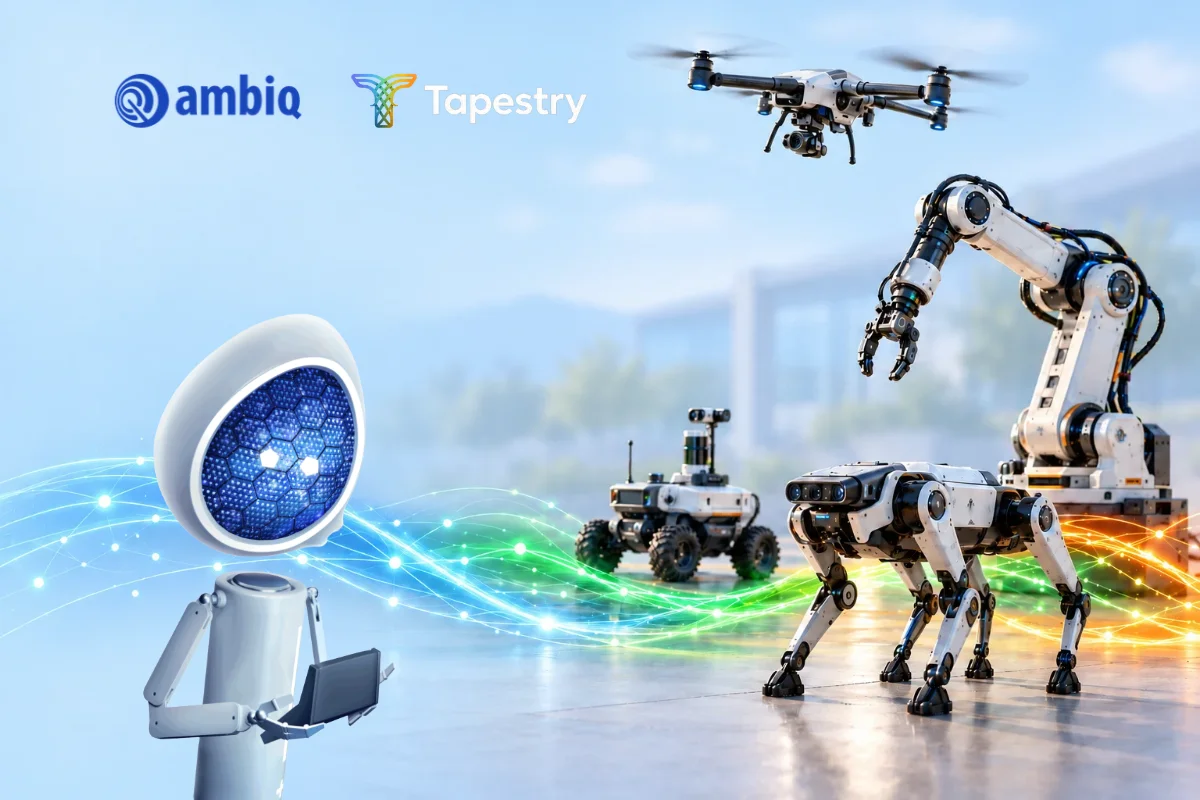
Ambiq’s Apollo SoCs use its patented Subthreshold Power Optimized Technology (SPOT®) platform for ultra-low-power processing for sensing and on-device AI. Tapestry lets devices share state and coordinate behavior through peer-to-peer communication over Bluetooth® Low Energy, without centralized control or cloud connectivity. Engineering teams can define how groups of devices should work together, while Tapestry manages information sharing and coordination across participating devices.
Tapestry OS’s initial bring-up on the Apollo platforms took less than a day and required no changes to its coordination layers. Ambiq said its expanded Zephyr RTOS support can reduce porting effort and make advanced software more accessible to developers building on ultra-low-power silicon.
At DARS 2026, the International Symposium on Distributed Autonomous Robotic Systems, October 26–29 in Tokyo, Tapestry OS plans to demonstrate ground robots collectively locating and surrounding a leak. If one robot loses power, the remaining robots reposition to maintain coverage without instructions from a central controller.
Tapestry OS is available as open-source software under the Apache 2.0 license, with support for Ambiq’s Apollo510 and Apollo330M Plus SoCs. Developers can access the project at github.com/tapestry-os/tapestry.