
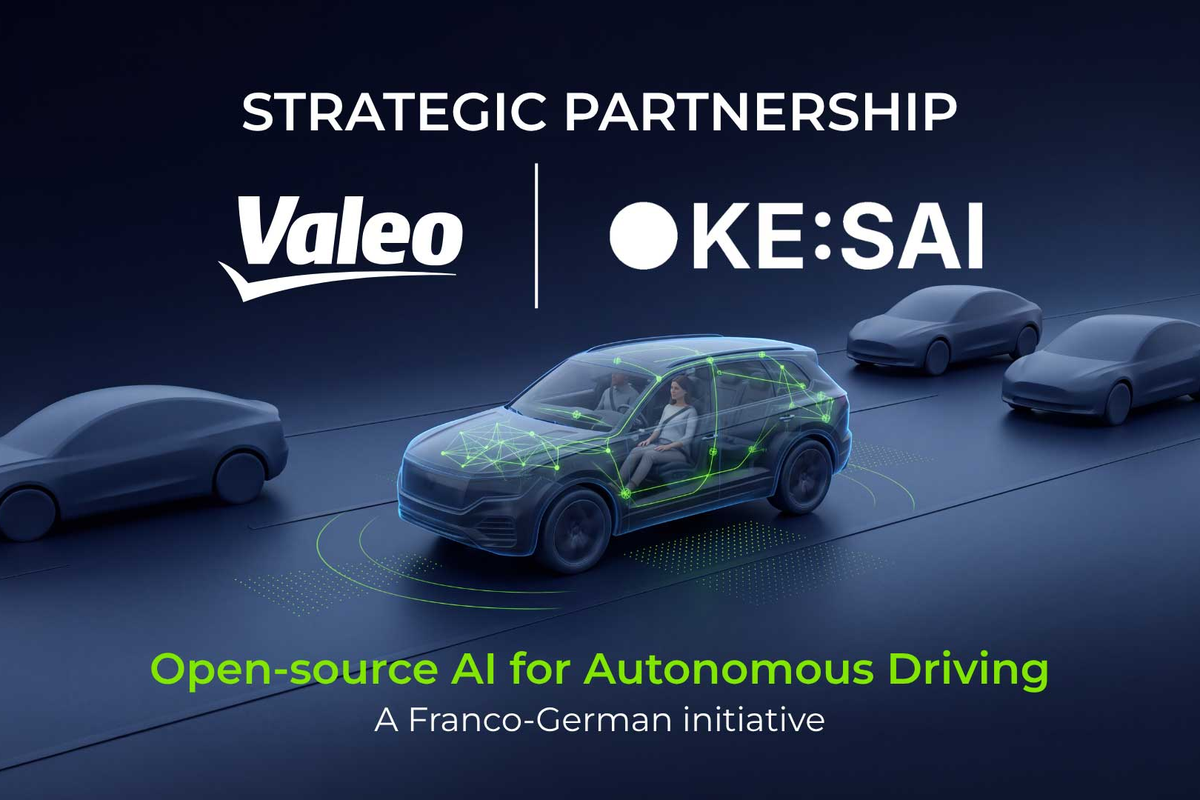
Valeo and KE:SAI (Kyutai ELLIS Scalable Autonomous Intelligence) will develop a generalist AI driving system for autonomous vehicles. The open-science research collaboration aims to make the system fully reproducible and release its code, trained models and datasets as open source.
The partners say autonomous driving models deployed in the automotive industry are nearly all proprietary, leaving automakers and suppliers without a shared, open foundation to build, compare and improve systems. They also point to open research questions around efficiency and generalization, which they say require exploring approaches across multiple labs.
The teams aim first to match, then push beyond, state-of-the-art performance across major public driving benchmarks. They plan to build one compact AI model that can drive different vehicles with different sensors in different environments. Training will begin with large-scale real-world driving recordings, with the model designed to transfer across sensor and camera configurations. Reinforcement learning in simulation and learned world models will expose it to rare and safety-critical situations that are scarce or absent in real-world data.
Marc Vrecko, CEO of Valeo Brain, said: “This open-science collaboration with KE:SAI marks a strategic milestone for Valeo and the broader European automotive ecosystem. By combining our deep industrial and technological expertise in autonomous driving with world-class open-source research, we are establishing a shared foundation to accelerate the development of physical AI and democratize next-generation self-driving technologies.”
The partners say findings will be shared through publications, allowing suppliers and researchers to reproduce results, build on the model and benchmark their systems against a common reference.