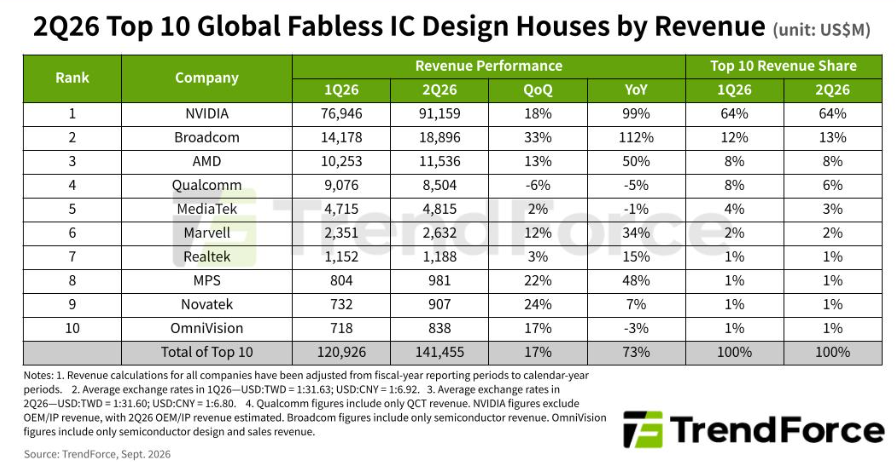
According to TrendForce's latest IC design industry research, expanding AI applications continued driving demand for GPUs, CPUs, ASICs, and interconnect products, pushing combined revenue of the world's top 10 fabless IC design companies up 73% year-over-year to more than $141.45 billion in the second quarter of 2026.
NVIDIA remained firmly in first place, while AMD moved up into third as CPUs gained renewed strategic importance for agentic AI applications. Qualcomm slipped to fourth amid weakness in its smartphone chip business.
NVIDIA's second-quarter revenue rose 99% year-over-year to nearly $91.16 billion, increasing its share of the top 10 companies' combined revenue to 64%. Beyond its usual customer base of hyperscale cloud providers, "neocloud" operators, and sovereign AI projects, enterprise customers also contributed significantly to the company's revenue this quarter.
TrendForce notes that NVIDIA has recently expanded its NVLink Fusion ecosystem, a technology that lets other chips connect to NVIDIA's infrastructure, enabling the company to engage with the broader custom ASIC market. NVIDIA's investment in MediaTek is intended to help custom accelerator (XPU) customers improve compatibility with existing NVIDIA infrastructure, while also laying groundwork for future automotive AI applications. NVIDIA's earlier investment in Marvell similarly included NVLink Fusion as an area of collaboration.
Agentic AI Elevates CPU's Strategic Role as Optical Interconnects Become Critical to Scaling Compute
Broadcom ranked second in the second quarter. The first ASIC it helped design for OpenAI, along with Google's TPU 8i chip, began shipping during the quarter, while its networking business grew rapidly alongside broader XPU deployments. Revenue surged 112% year-over-year to more than $18.89 billion. Its six major custom chip customers, including frontier AI model developers like Anthropic and OpenAI, are expected to continue driving demand for custom accelerator chips.
AMD moved into third place as the rise of agentic AI renewed the strategic importance of CPUs. Second-quarter revenue exceeded $11.53 billion, with data center CPU revenue reaching a record high for the fifth consecutive quarter. The company also continued gaining market share from Intel in the x86 server chip market.
Rapid growth in demand for interconnect technology lifted Marvell's second-quarter revenue to $2.63 billion, placing it sixth. The company holds a leading position in PAM4 DSPs, chips used to process high-speed optical signals, with strong demand for 800G versions and a rapid ramp-up in newer 1.6T products. Marvell has also reached an agreement with Google in its custom silicon business, which is expected to make a significant revenue contribution starting in fiscal year 2029.
Mobile Chip Leaders Expand Their AI Strategies
In the second quarter, Qualcomm faced ongoing challenges in its smartphone chip segment and a reduced share of modem chips in the newest iPhone. Even so, its automotive division has sustained double-digit year-over-year growth for 23 consecutive quarters, helping offset part of the decline in smartphones. The company earned more than $8.5 billion in revenue. Qualcomm has also recently returned to the data center market, boosting diversification within its chip division.
MediaTek ranked fifth with revenue of approximately $4.81 billion, also weighed down by its smartphone business. However, the company raised its outlook for AI ASICs and expects data center revenue to exceed $2 billion in 2026. It has also increased its estimate for the total addressable market for ASICs to $80 billion by 2028.
Consumer IC Design Houses Benefit from Early Pull-In Demand While Seeking New Growth Drivers
Realtek ranked seventh with second-quarter revenue of nearly $1.19 billion. With PC market conditions expected to weaken further in the second half of 2026, the company plans to leverage its existing intellectual property strengths to expand into the server market, including 10G Ethernet and server control-plane switches.
MPS ranked eighth with revenue of $981 million, driven primarily by AI-related power management solutions. The company continues expanding capacity as it transitions toward becoming a broader semiconductor solutions provider.
Novatek ranked ninth with second-quarter revenue of $907 million, supported by early pull-in demand from customers. Systems-on-chip now account for more than half of its revenue, and the company continues investing in edge AI-related machine-vision SoC applications.
OmniVision ranked tenth, with semiconductor design revenue of $838 million. Although higher memory prices weighed on its smartphone and automotive image-sensor businesses, emerging applications such as action cameras posted strong growth. The company is also expanding its analog IC portfolio into components for optical communications, including transimpedance amplifiers (TIAs) and driver ICs.