
Seoul Semiconductor and its affiliate Seoul Viosys, both South Korean opto-semiconductor technology companies, have secured a permanent injunction in India blocking infringement of Seoul's opto-semiconductor patents, adding to similar injunctions the companies previously won in Europe and the United States. In India, the Delhi High Court extended the injunction to cover the managing director of the infringing company as well.
Opto-semiconductors are chips that convert between light and electrical signals, used in applications like LED lighting, displays, and optical communications, and Seoul frames these rulings as significant for that industry globally, a market estimated at roughly $200 billion that's expanding beyond traditional uses like automotive lighting and displays into optical communications supporting AI applications.
In the India case, Seoul Viosys won a final judgment against Ornate Agencies Private Limited, resulting in an injunction blocking the sale of products that infringe on Seoul's patents, along with a separate order barring the company's managing director personally from further infringement.
ADVERTISEMENT
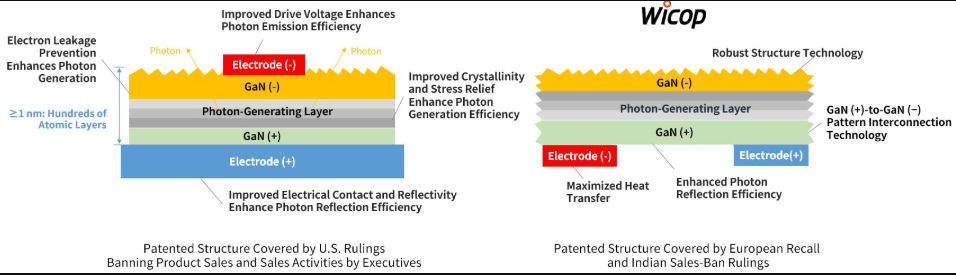
This follows a ruling last June from the Unified Patent Court in Europe, which confirmed a permanent injunction against products infringing Seoul's WICOP technology, a technology related to LED structure design, along with an order requiring infringing products already sold to be recalled and destroyed. That kind of remedy goes beyond financial damages or royalty payments, forcing companies to pull products from the market entirely at significant cost.
In February, a U.S. court issued a separate permanent injunction against Laser Components USA, a European opto-semiconductor applications company, for infringing patents held by a Seoul affiliate. The infringing products in that case incorporated chips supplied by Korean company Photon Wave. The injunction blocks sales of the infringing products, as well as any substantially similar products made using the same manufacturing process, and extends to Laser Components' officers, agents, and employees, along with any Photon Wave personnel found to be acting in concert with Laser Components in the infringement.
ADVERTISEMENT
Together, the three lawsuits covered patents on core opto-semiconductor technologies, including Seoul's light-output enhancement technology, its WICOP LED structure technology, and a water purification technology, with applications spanning automotive lighting, displays, mobile devices, general lighting, and emerging AI data communications. These patents are part of a broader portfolio of roughly 15,000 patents held by Seoul Semiconductor and Seoul Viosys. The company frames these consecutive wins across Europe, the U.S., and India as evidence of the strength of its core technology and its position as a global technology leader in the space.
Company founder Chung hoon Lee, who built the business from scratch at a time when South Korea had no opto-semiconductor industry, said the patent system reflects his belief that while birth isn't fair, opportunity should be, arguing that patent protections helped drive past industrial revolutions and sharply reduced poverty and infant mortality by the year 1900. He added that just as ordinary people in countries that respect intellectual property can achieve major success, the patent system needs to impose strict penalties on the leaders of infringing companies, as courts around the world have now done in these cases, so that patents are respected globally and young people and entrepreneurs everywhere can pursue their ambitions with confidence.