
Rice University and its collaborators held the first hands-on workshop on Phlex, the next-generation software framework being developed for the Deep Underground Neutrino Experiment (DUNE), at the Indian Institute of Science (IISc) in Bengaluru. The event was organized through a collaboration between Rice Global India, HSF-India and DUNE-TECH, a Department of Energy-funded DUNE training and workforce development program led by Rice.
DUNE will send an intense beam of neutrinos from Fermilab, near Chicago, 1,300 kilometers through the Earth to liquid-argon detectors nearly a mile underground in South Dakota. Scientists will observe how the neutrinos change along the way, in hopes of understanding why the universe is made of matter rather than antimatter.
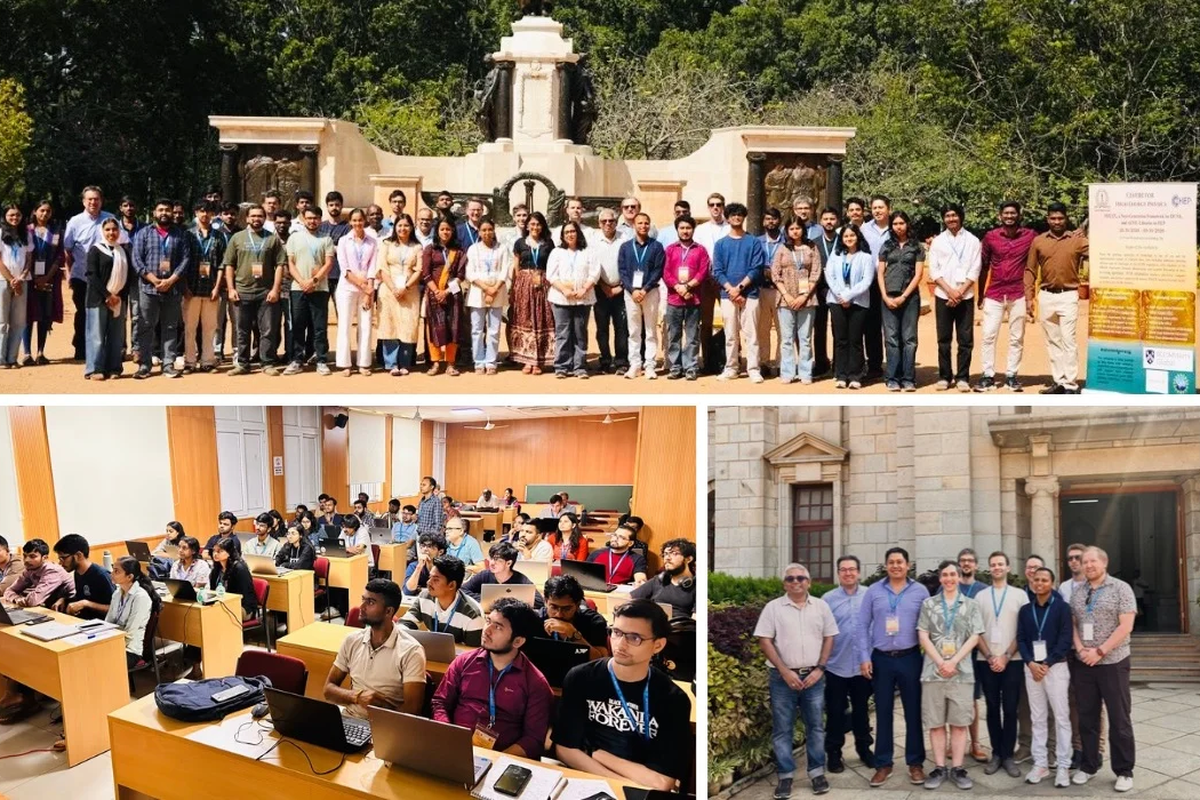
DUNE relies on software to collect and analyze its data. Phlex, short for Parallel, Hierarchical and Layered EXecution of data-processing algorithms, lets physicists write algorithms once and run them efficiently on modern computing resources. For the first time, workshop participants were able to use and explore the framework as users. They also learned about AI and machine-learning libraries used in high-energy physics analysis and attended lectures on neutrinos and DUNE.
Kyle Knoepfel, a Fermi National Accelerator Laboratory scientist and Phlex developer, said the workshop showed that the framework’s conceptual design made sense to people without prior experience using data-processing frameworks. He said participant feedback would help Phlex developers improve the user experience.
The event brought together people from 15 institutions across India. Aaron Higuera, an assistant research professor at Rice and chair and lead organizer of the event, said the workshop helped build a community ready to contribute to DUNE and its next-generation framework, and strengthened research-software ties between India and the U.S.