
Keysight Technologies, announced an Electrical-Optical-Electrical (EOE) simulation solution in ADS 2026. The solution enables engineers to simulate complete electrical-to-optical-to-electrical signal chains within a single design environment. It addresses the growing need for modeling interactions across electrical and optical domains in AI infrastructure and high-performance computing applications that require faster optical links.
According to the announcement, 87% of hyperscale optical transceivers will operate at 800Gbps or higher by 2029, with 1.6Tbps and 3.2Tbps expected later. The EOE capability integrates Keysight’s High Speed Digital workflow with Keysight Photonic Designer to simulate the full signal path from transmitters through optical and photonic circuits to electrical receivers.

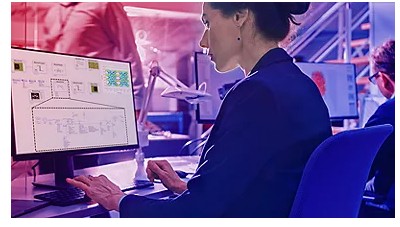
This unified workflow allows evaluation of electrical and optical design tradeoffs and signal integrity against high-speed standards earlier in the design cycle. It replaces legacy approaches that required separate tools and manual combination of results.
Key capabilities include:
- Simulation of high-speed SerDes digital channels and photonics IC behavior together to detect cross-domain signal integrity issues.
- Full-duplex optical simulation for bidirectional links, capturing forward and backward signal propagation.
- Wavelength division multiplexing support to assess nonlinear effects across multiple wavelengths in multi-lane interconnects.
- Simultaneous noise modeling across electrical and optical domains for realistic system-level signal quality assessment.
- Capture of modulator bias-dependent and large-signal nonlinear effects.
- Patented multi-domain co-simulation for electrical-optical design tradeoffs in one environment.
ADS 2026 also supports the full design flow from system to component level through PDK support and Keysight RSoft integration for photonic IC representation.
Niels Fache, Senior Vice President, Keysight, said: “AI infrastructure depends on 800 Gbps and 1.6 Tbps optical links to move data at scale. At these speeds, electrical and optical performance can no longer be modeled separately. With ADS 2026, engineering teams now have the ability to simulate those interactions before committing to silicon.”