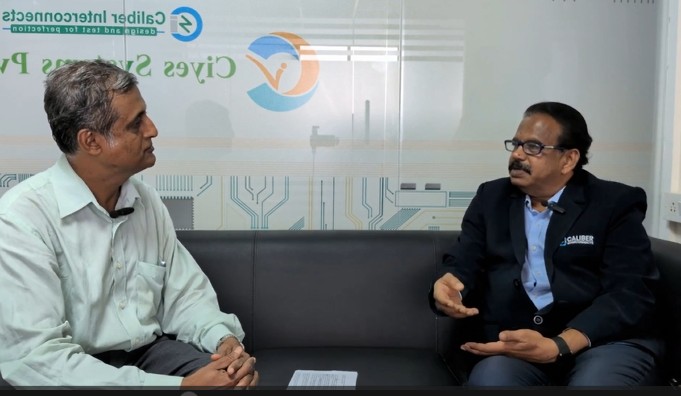

Coimbatore-based Caliber Interconnect has grown into a significant player in the semiconductor supply chain, expanding its workforce from around 500 to nearly 1,000 employees in recent years. In an exclusive interview with Srinivasa Reddy N., Editor-in-Chief of EEHerald, CEO and Founder Suresh Babu shared insights into the company’s evolution, operational strategies, diversification efforts, and contributions to India’s emerging semiconductor ecosystem.
On Company Evolution and Services
Babu explained that the company began with design services and has since expanded comprehensively. “Over a period of time, we have grown as an important player in the semiconductor supply chain. Our services include test engineering, test hardware design and development, package designing, simulation, and kind of some amount of manufacturing also,” he said. The company is now planning to venture into advanced manufacturing.
He attributed the current strong growth to the AI boom, noting that the team is “very busy with the positive market.”
Driving Factors Behind Rapid Staff Growth
When asked about the significant increase in headcount, Babu highlighted test engineering as the primary growth driver. “The market is very good recently because electronics is everywhere. The brain of any electronics is the semiconductor,” he remarked. With more semiconductors entering the market, the need for testing and validation has surged. Long-standing credibility, repeat business from trusted global customers, and the company’s focus on critical services have further fueled this expansion.
Global Collaboration Across Time Zones
Caliber operates teams in Coimbatore, Singapore, Bangalore, Malaysia, Taiwan, Israel, and Japan to serve customers worldwide. Babu emphasized the importance of robust processes: “We have a very good process over the period of time… all of our engineers are working from morning to midnight” across time zones. Teams are structured to support specific customers, supported by clear communication, automation, and strict process adherence. “If process is a mistake, everything is gone,” he noted, stressing the need to culturally build discipline so engineers follow protocols rigorously.
ADVERTISEMENT

Diversification into Products and Applications
The company has extended beyond core testing into product development, including EV charging and AI applications. Babu described this as a natural progression: working on chips for RF communication and power devices gives deep application knowledge, leading to system boards, evaluation boards, and complete electronic systems. “From chips to systems… It took us to the next level of a product development,” he explained.
Supporting India’s Semiconductor Ecosystem
Babu expressed strong support for the government’s initiatives. After 25 years primarily serving overseas clients, the company is eager to apply its experience domestically. “We are very happy to first of all support the Indian government’s initiative to build a very good semiconductor ecosystem,” he said, while looking forward to fabrication capabilities within India by 2028.
He acknowledged initial challenges in building the ecosystem but remained optimistic: “India is such a big country and such a huge talent. These problems definitely we can overcome.”
Talent Development and Industry-Academia Collaboration
Talent remains a key focus. Caliber works with institutions like Shastra University and SRM University, recommending curricula, training faculty, and providing in-house programs that bring fresh engineers to production level within six months. Babu stressed training faculty first, as “the quality of the faculty is reflected in the quality of the candidates,” and welcomed government grants supporting semiconductor education and fab training.
ADVERTISEMENT
Call for IP Development and Parallel Technologies
Looking ahead, Babu believes India must move beyond being a cost-efficient service center. “We have to develop a parallel technology… We need to build a parallel technology” in areas such as semiconductor machinery, EDA tools, software, equipment, and communication protocol standards.
Emerging Technologies and R&D Focus
On technologies like chiplets, silicon photonics, and neuromorphic computing, Babu sees “very immediate opportunities.” The company maintains over 12 PhD holders dedicated to R&D and is open to adding more scientists. It is already prepared with chiplet and photonic solutions. AI is leveraged internally for automation and handling large data volumes in testing processes.
Advice to Aspiring Startup Founders
Addressing young entrepreneurs, Babu offered clear guidance: “First thing, you have to create something which addresses their market pain points. First comes the creation, then comes the whole other management.” He emphasized building a strong technology and business model, maintaining resilience through challenges, and cultivating persistence: “You always should be strong in your heart… If you give up, then you cannot actually be a successful person. You have got to wait.”
The interview underscores Caliber Interconnect’s position at the intersection of global expertise and India’s semiconductor aspirations, driven by process discipline, talent investment, and forward-looking innovation.