
Spectrum Instrumentation has introduced a new Direct Digital Synthesis (DDS) option for its 65xx series Arbitrary Waveform Generators (AWGs). This option provides a method for generating sinusoidal signals, finely tuneable reference sources, combined sine waves, waveform trains, frequency sweeps, and modulated signals.
The release completes the rollout of DDS functionality across Spectrum’s entire AWG portfolio, which now includes more than 70 DDS-enabled product variants. These support multitone and multichannel signal generation with bandwidths up to 3.9 GHz.
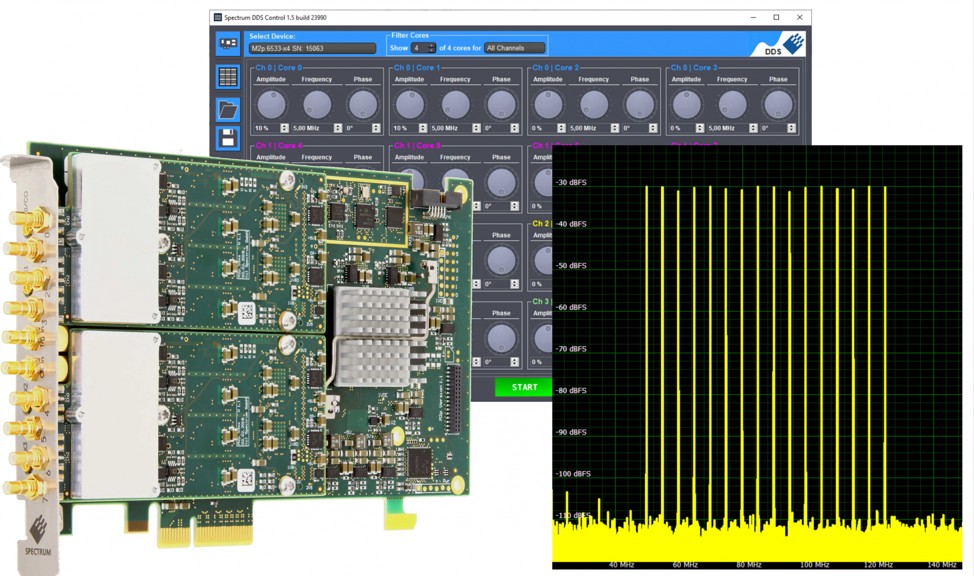
In DDS mode, each channel of the 65xx series AWGs can generate up to 16 individual sine wave tones. Frequency, amplitude, and phase are controlled through simple commands, with parameter changes possible at 8 nanosecond spacing. This enables the creation of multitone and modulated signals without large data transfers or complex waveform calculations. An FFT display illustrates the multiple sine waves.

The 65xx series combines traditional AWG operation with DDS mode in a single instrument. In standard AWG mode, it is designed for test and measurement applications, with output rates from 40 MS/s to 125 MS/s, 16-bit resolution, and bandwidths up to 70 MHz. Cards provide 1 to 8 channels, and systems can scale to 80 fully synchronized channels. Products are available as PCIe cards for PC-based systems and LXI stand-alone instruments for Ethernet-based control in laboratory and production environments.
In DDS mode, features include frequency and amplitude slopes, along with flexible command sequencing for real-time signal adaptation. These are applicable in scenarios requiring agile frequency sources, such as identifying resonant frequencies or compensating for system drift in network stimulation, automated testing of filters and amplifiers, or operation of medical and industrial sensors.
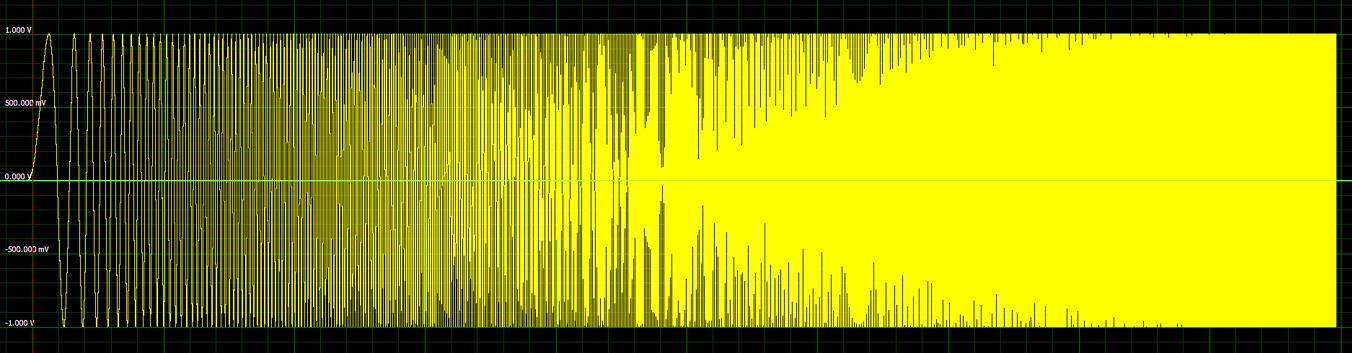
One example demonstrates a slowly swept sine wave from 20 Hz to 20 kHz, used to drive vibration shakers for identifying mechanical resonance and fatigue in automotive and aerospace applications. The DDS option supports up to 16 parallel sweeps with different frequency ranges to reduce test time.
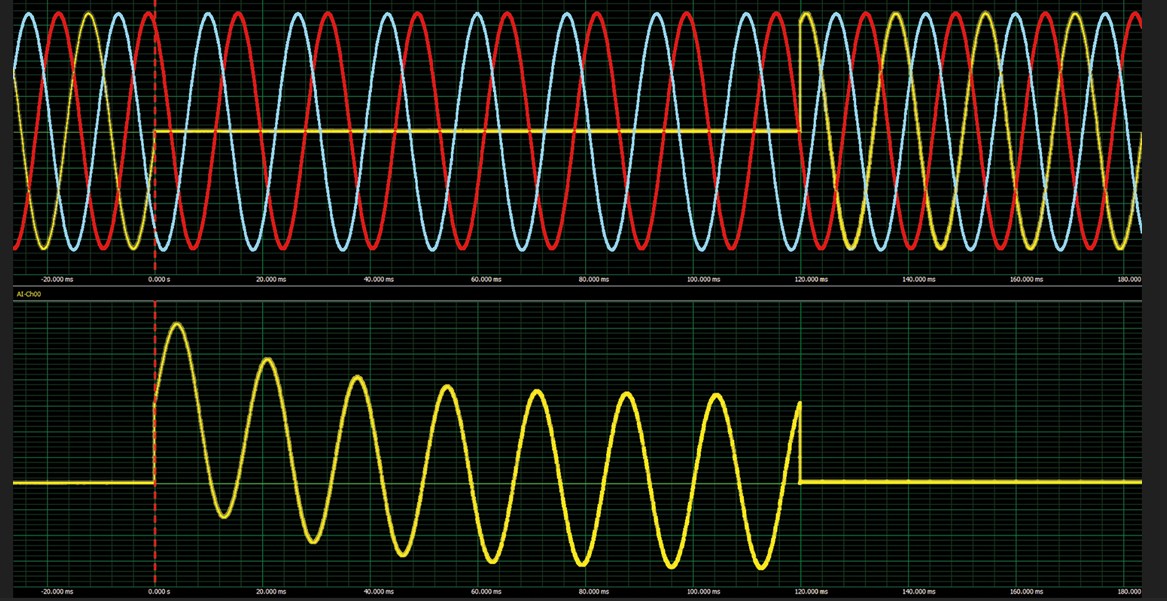
Another example shows simulation of voltage and current transducer outputs for circuit fault detection. One trace simulates a three-phase power fault with a line-to-ground fault on phase A, while another shows the resulting phase A current as an exponentially decaying waveform, illustrating the generation of non-sinusoidal waveforms.
All 65xx series instruments use Spectrum Instrumentation’s unified software toolkit for computer-controlled operation. Support covers Windows and Linux, with programming examples for Python, MATLAB, C++, and LabVIEW, plus a high-level Python API. A complimentary “DDS CONTROL” GUI allows signal generation and control without programming.
Products include lifetime technical support from Spectrum Instrumentation’s engineering team, along with free software and firmware updates.
A 5-minute product video demonstrating the DDS option is available at https://youtu.be/J77Jo5H53VM.