
OMNIVISION has announced the OG05D, which it calls the industry's first 2.2 µm, 5-megapixel global shutter (GS) high dynamic range (HDR) CMOS image sensor built specifically for industrial machine vision. The announcement was made from Santa Clara, California, on October 5, 2026. Target applications include barcode scanners, factory automation, compact AI cameras, and humanoid robotics, especially data-collection devices used for robotics training. At a maximum of 146 frames per second (fps) in linear mode, the OG05D is 143% faster than previous-generation sensors.
The sensor combines Nyxel near-infrared (NIR) technology, HDR, low power consumption, and a compact optical format in a stacked backside-illuminated (BSI) design, which suits systems where imaging performance, sensor size, and power efficiency all matter. It captures high dynamic range in a single exposure, reducing the motion artifacts that come with multi-exposure HDR approaches. Its RGB-IR on-chip processing, higher NIR quantum efficiency (QE), and low noise from dual conversion gain (DCG™) help it overcome the limits of traditional non-HDR sensors, and it is 30% smaller than previous-generation sensors.
Kelly Yan, staff product marketing manager at OMNIVISION, said the rapid growth of industrial machine vision and robotics is driving demand for sensors designed for these new applications. She said the OG05D combines compact size, high-speed imaging, excellent HDR performance, and industry-leading low power consumption, so customers can build smaller, more capable, and more power-efficient vision systems.
The OG05D comes in a 1/2.5-inch optical format with a stated package size of 6.6 µm x 5.3 µm, making it a good fit for robotic, industrial, and embedded AI camera designs. DCG HDR captures scenes with both bright highlights and dark shadows, improving object detection and navigation where lighting changes often, such as in factories, warehouses, and outdoors.
Key features include a 2.2 µm 5 MP BSI global shutter with the industry's smallest HDR-capable pixel (over 70 dB), and Nyxel technology that raises NIR QE to above 55% at 850 nm and above 35% at 940 nm. Power use is 30% lower than the previous-generation 5 MP product. HDR support includes 60 fps DCG single-exposure on-chip HDR combination and 60 fps 3-exposure on-chip HDR combination. The sensor supports RGB, mono, and RGB-IR, with RGB-IR on-chip re-mosaic. It is available now for sampling, with mass production planned for Q4 2026. OMNIVISION will exhibit at the VISION Show in Stuttgart, Germany, October 6-8, 2026, in Hall 10, Booth 10D10.
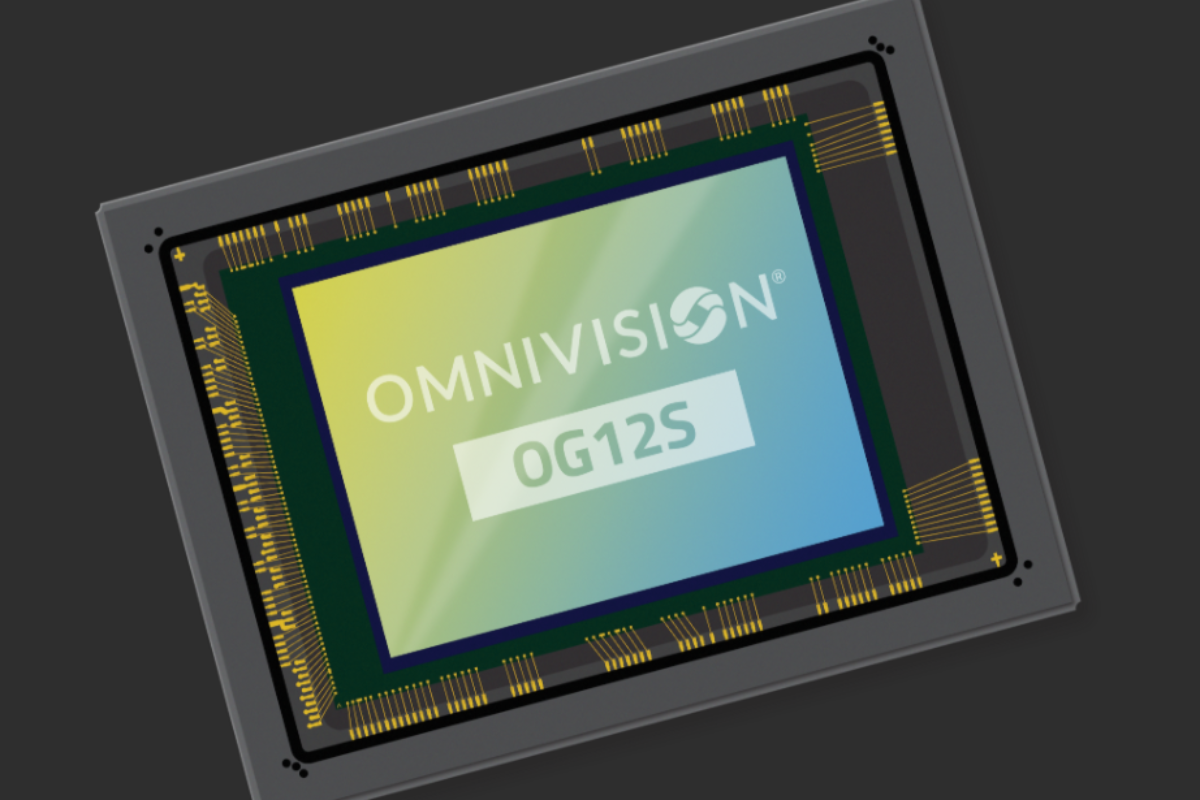
OMNIVISION Launches New 12MP Global Shutter Sensor for Factory Automation and Intelligent Transportation Systems. OMNIVISION has also introduced the OG12S10, a 12-megapixel (MP) backside-illuminated (BSI) global shutter (GS) CMOS image sensor for factory automation and intelligent transportation systems (ITS), announced from Santa Clara on October 5, 2026. Its large 3.45 µm pixel provides exceptional sensitivity and high quantum efficiency (QE), and it supports an ultra-short 1 µs exposure time for precise control in high-speed motion scenes.
The OG12S10 uses PureCel Plus-S pixel technology with on-chip dual conversion gain (DCG) high dynamic range (HDR) and offers a 4096 x 3072 resolution. Nyxel near-infrared (NIR) technology enables clear image capture with high pixel sensitivity and no motion artifacts, and a 12-bit ADC further improves image quality. At up to 75 fps, the sensor can easily capture fast-moving objects.
Kelly Yan, staff marketing manager at OMNIVISION, said that where speed, vibration, and motion are constant, image clarity becomes critical, yet not every sensor can deliver consistent results in those conditions. She explained that global shutter sensors like the OG12S10 solve this by capturing each frame with synchronized exposure, eliminating motion-related distortion.
Key features include a 3.45 µm BSI pixel in a 1.1-inch optical format and 74 dB dynamic range with DCG HDR. In DCG mode it offers a 20,000-electron (20 Ke-) full well capacity and 2.8 e- read noise. Nyxel technology delivers QE of 60% at 850 nm and 40% at 940 nm, a 5x boost over the existing 3.45 µm product, along with 106 dB shutter efficiency and PureCel Plus-S die stacking. The interface options are 16-lane sub-LVDS up to 1.1 Gbps and 4-lane MIPI. The sensor comes in a ceramic land grid array (CLGA) package, with sampling available in November 2026 and mass production planned for Q4 2026.