
World's most widely used non-volatile memory Flash memory is limited by performance such as data-access-speed, bit-access, and data retention life. The research trend now in memory technology is to find a single memory for both temporary storage and permanent storage in personal computers as well as embedded systems. Research trend now in memory is unification of memory, so that there should be no separate SRAM, DRAM and flash, it's going to be just one memory. In this article we are going to provide what are the commercial devices already available, which can replace flash memory and other semiconductor material silicon based memory.
This article provides details of non-volatile components and the IC chips that are available in the market today. Some of these devices hold content without power (non-volatile), but has the speed and random access capability of DRAMs/SRAMs
Phase Change Memory (PCM)
Introduction
The data switch (0 to 1) in PCM is based on the resistance difference of two phases (Crystalline & Amorphous). PCM is designed to eliminate DRAM and flash with single alternate memory. "Phase change RAM" (PRAM and PCRAM), "chalcogenide RAM" (C-RAM) and Ovonic Unified Memory are other names for phase change memory (PCM). PRAM is acronym used by Samsung.
PCM is said to offer high performance and low power consumption, combing the best specifications of NOR, NAND and RAM within single chip. PCM advantages include single-bit read/write capability, non-volatile, fast data access speeds while reading, fast data write/erase speed, and good scalability.
PCM memory IC selection table from important vendors:


Datasheet and detailed information of the above parts visit:
NUMONYX1
NUMONYX2
SAMSUNG

Notes
- Boffins at IBM Research in Zurich, Switzerland have come up with a new encoding technique that will allow for multi-level cell (MLC) phase change memory to be commercialized at some point in the not too distant future. More info: PCM
- Samsung presented 58nm 1.8V 1Gbit PRAM and releases 512Mbit PCM with 65nm process, in Multi-chip package.
- Samsung has developed an 8Gb PCM that has an interface speed of 40Mbps using the LPDDR2-interface.
- Numonyx announces 1Gb 45nm product and releases Omneo PCM series (P8P & P5Q), both in 90nm.
Ferroelectric RAM (FRAM or FeRAM)
Introduction
FFRAM combines the best of RAM and ROM into a single package that outperforms other non-volatile memories with fast writes, high endurance and ultra-low power consumption.
FRAM has 10K times greater endurance and 3K times less power consumption than a typical serial EEPROM device, and nearly 500 times the write speed.
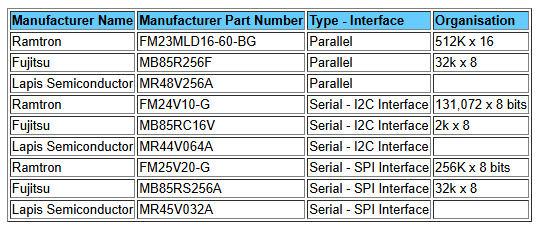
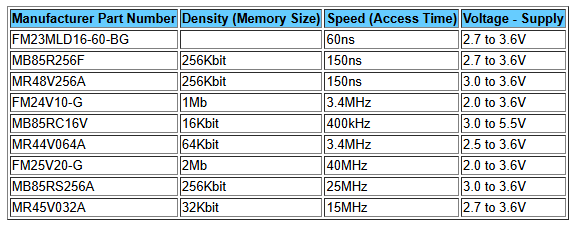
F-RAM, FeRAM and FRAM are synonymous. Texas Instruments have chosen to use the acronym FRAM while Ramtron uses F-RAM.FRAM IC selection table from key vendors:
For data sheet of above parts visit:
Datasheet 1
Datasheet 2
Datasheet 3
Datasheet 4
Datasheet 5
Datasheet 6
Datasheet 7
Datasheet 8
Datasheet 9
Notes
Ramtron provides important notes on the observation made on a counterfeit component FM25160. More details are at ramtron
Texas Instruments is producing Ramtron's 4Mb & 2Mb FRAM memory on it's advanced 130nm FRAM manufacturing process. More details about TI's FRAMs can be viewed atTI mcu
Ramtron has unveiled the FM25V20, a 2-megabit (Mb) high performance serial F-RAM device. The FM25V20 is a member of Ramtron's V-Family of F-RAM products, which offers a wide operating voltage range of 2.0 to 3.6-volts
Magneto Resistive RAM (MRAM)
Introduction
MRAM uses electron spin to store data and is also called as Universal memory - offering the density of DRAM with the speed of SRAM and non-volatility of FLASH memory/ disk drives. MRAM consumes less power, resists high radiation and operate in extreme temperatures making it suitable for mil and aerospace applications..
There are several 'newer' types of MRAMs - STT-RAM, NV-RAM, etc.,
MRAM IC Table
For datasheet of above parts visit:
Notes
Everspin Technologies MRAM products: Parallel MRAMs have SRAM read and write cycle times and asynchronous timing interfaces that use standard SRAM access timing. Serial MRAMs have the same SPI interface as Flash and EEPROM but with fast 40MHz clock speed and no write delays.
Renesas plan to have 100 to 150MHz MRAM at 90nm around 2010, and 200Mhz MRAM at 65nm around 2012.
Hynix Semiconductor and Toshiba have agreed to strategic collaboration in the joint development of Spin-Transfer Torque MRAM.
Other not so commercialized non-volatile memory technologies:
Nano-RAM (NRAM)
Nano-RAM is a proprietary computer memory technology of Nantero, Inc. NRAM is a type of NV memory based on the mechanical position of carbon nanotubes deposited on a chip-like substrate.
Memristor
Memristor, a short name for memory-resistor is invented by HP as a fourth circuit element after resistor, capacitor and inductor. It is seen as a replacement for flash memory. The fundamental operation is little complex. More proper explanation can be found at: http://spectrum.ieee.org/semiconductors/design/the-mysterious-memristo
Also for more details refer: http://www.hpl.hp.com/news/2008/apr-jun/memristor_faq.html
Currently, IBM, HP, Samsung, and many other research labs seem to be hovering around the titanium dioxide memristors. The first products using memristor technology are expected to become available around 2013.
Programmable Metallized Cell (PMC)
PMC is a new of Non-Volatile Memory being developed at Arizona State University as a replacement for flash memory, providing a combination of longer lifetimes, lower power, and better memory density.
Infineon Technologies has licensed the technology in 2004 and calls it conductive-bridging RAM, or CBRAM. NEC has a variant called "Nanobridge" and Sony calls their version "electrolytic memory".
Axon Technologies, Micron Technology & Infineon have been licensed the basic concept of this technology and are working on it.
But you still use flash memory to store your code find in the link below some popular parts of NOR Flash type:
Flash memory chips for your embedded system design
Note: The specification provided above are only indicative for clarification consult the manufacturer of the part: