

IBM announced that its quantum computer has simulated a real magnetic material with results that match neutron scattering experiments conducted at national laboratories. The work was performed by a team from the U.S. Department of Energy-funded Quantum Science Center at Oak Ridge National Laboratory, Purdue University, University of Illinois Urbana-Champaign, Los Alamos National Laboratory, the University of Tennessee, and IBM. The findings were reported in a pre-print.
The simulation focused on the magnetic crystal KCuF3. Researchers directly compared quantum computer simulations with neutron scattering measurements, which reveal quantum properties of materials by tracking how neutrons exchange energy and momentum with spins in the material. The agreement between the experimental neutron data and the quantum simulation demonstrates that current quantum processors can capture key dynamical properties of real materials.
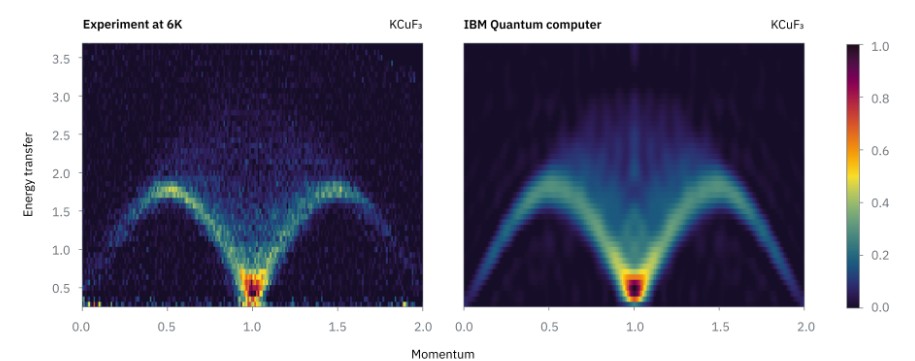
The results were enabled by quantum-centric supercomputing workflows and reductions in hardware error rates, particularly two-qubit error rates on IBM’s quantum processors. The team used a universal quantum processor and has extended the approach beyond KCuF3 to simulate material classes with more complex interactions.

Arnab Banerjee, assistant professor of Physics and Astronomy at Purdue University, noted that neutron scattering data on magnetic materials often remains incompletely understood due to limitations of classical methods. He described the quantum simulation as realizing a long-standing goal of comparing experimental data with quantum computations.
Allen Scheie, condensed matter physicist at Los Alamos National Laboratory, stated that the match between experimental data and qubit simulation is the most impressive he has seen and raises expectations for quantum computers in science.
Travis Humble, director of the Quantum Science Center at Oak Ridge National Lab, said the quantum simulation of realistic material models alongside experimental characterization represents a major demonstration of quantum computing’s potential impact on scientific discovery workflows.
Abhinav Kandala, principal research scientist at IBM, explained that the accuracy was made possible by accessible two-qubit error rates and that further improvements in error rates and extensions to higher dimensions are expected to enable predictions of material properties challenging for classical methods.
The demonstration indicates that quantum computers, combined with new algorithms and quantum-centric supercomputing workflows, can already simulate material properties that are difficult to predict using classical methods alone. This work contributes to efforts in materials discovery with potential long-term implications for superconductors, medical imaging, energy, and drug development.
The quantum-centric supercomputing approach integrates today’s quantum hardware with classical computing in workflows designed to deliver scientific and commercial value. The experiment forms part of a broader application of quantum simulation to problems in chemistry, materials science, and molecular biology, including prior simulations of a half-Möbius molecule and large-scale protein structures.