
HORIBA India, a subsidiary of the Japan-based HORIBA Group, has entered into a Memorandum of Understanding (MoU) with IIT Delhi to fund three technical development research projects as part of its Corporate Social Responsibility (CSR) initiative. The projects focus on developing a low-cost, high-torque density reduced rare-earth magnet-based electric vehicle (EV) motor, 3D printing of smart fabrics and innovative design prototypes, and an intermediate-temperature proton-conducting solid oxide electrolysis cell (H-SOEC) for green hydrogen generation.
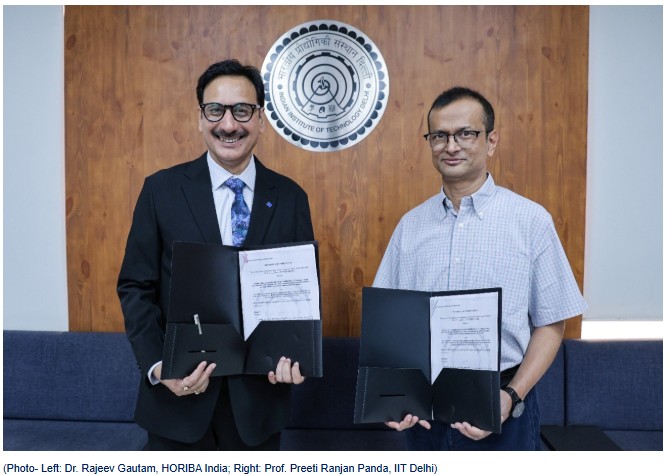
The MoU was signed by Prof. Preeti Ranjan Panda, Dean of Corporate Relations at IIT Delhi, and Dr. Rajeev Gautam, Senior Corporate Officer at HORIBA Ltd., Japan, and President of HORIBA India. The signing took place in the presence of Dr. Sagar Sarkar, Assistant Professor of Mechanical Engineering and Principal Investigator (PI) for the EV motor project, Prof. Saptarshi Basak from the Centre for Automotive Research and Tribology (CART), PI for the 3D printing project, and Prof. Suddhasatwa Basu from the Department of Chemical Engineering, PI for the green hydrogen project.
HORIBA India, headquartered in New Delhi, operates in three business verticals: Energy and Environment, Bio and Healthcare, and Materials and Semiconductor. Dr. Rajeev Gautam stated that the collaboration aims to support modern technologies and contribute to scientific skill development by providing advanced equipment and educational opportunities for students. Prof. Preeti Ranjan Panda noted that HORIBA India’s prior CSR contributions have supported education and skill development for students with disabilities at IIT Delhi, and this new initiative is expected to further strengthen the partnership.
Back in February 2022, HORIBA India and IIT Delhi had established the HORIBA India-IIT Delhi Technical Center at the Department of Chemistry, IIT Delhi, to advance industry-academia research collaboration. The center is equipped with a Laser Diffraction Particle Size Analyzer (LA-960), capable of measuring particle sizes from 10nm to 5000um for both wet and dry samples.
The LA-960 system provides particle size distribution data critical for applications such as paint glossiness, cocoa powder flavor, highway paint reflectivity, cement hydration and strength, pharmaceutical absorption rates, and cosmetic appearance. The MoU for the center was signed on February 14, 2022, by Prof. V Ramgopal Rao, then Director of IIT Delhi, and Dr. Rajeev Gautam, President of HORIBA India.