
Researchers at the Jawaharlal Nehru Centre for Advanced Scientific Research (JNCASR), an autonomous institute under the Department of Science and Technology (DST) in Bengaluru, have developed a sodium-ion battery (SIB) capable of charging to 80% in six minutes and enduring over 3,000 charge cycles. The battery utilizes a NASICON-type cathode and anode material.
Led by Prof. Premkumar Senguttuvan and Ph.D. scholar Biplab Patra, the team engineered a new anode material, Na₁.₀V₀.₂₅Al₀.₂₅Nb₁.₅(PO₄)₃, optimized through three methods: reducing particle size to nanoscale, applying a thin carbon coating, and incorporating aluminium to enhance sodium-ion movement. These modifications improve charging speed and battery longevity compared to conventional sodium-ion batteries, which often face slow charging and short lifespans.
Sodium, abundant and inexpensive in India, offers a cost-effective alternative to lithium, which is scarce and mostly imported. This development aligns with India’s Atmanirbhar Bharat mission to achieve self-reliance in energy storage technology. The battery could potentially power electric vehicles, solar grids, drones, and rural households.
The technology has been validated through electrochemical cycling and quantum simulations, demonstrating reduced fire and degradation risks compared to traditional batteries. While further development is required for commercialization, the discovery is a step toward advancing energy storage solutions.

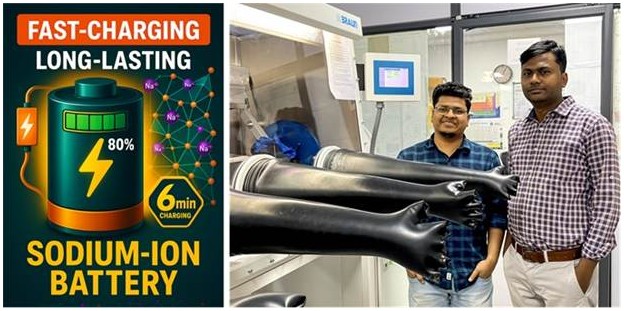
Fig: (left) Fast charging sodium ion battery; (right) Researchers of this discovery - Mr. Biplab Patra (Ph.D student, JNCASR) and Prof. Premkumar Senguttuvan, Associate Professor, JNCASR