
Panasonic Holdings Corporation and its research collaborators have developed Tactile-Reactive Dexterous Manipulation (T-Rex), a robot AI for bimanual tasks that achieved a 65% average success rate across 12 real-world evaluations.
People adjust their movements using fingertip feedback about force, slippage and deformation when carrying out tasks such as pulling out a thin card or inserting and turning a key. Conventional VLA models rely mainly on camera images, and models that use tactile information often treat it as static input. Panasonic identifies limited tactile training data and the gap between vision-language models’ update rates and the control frequency needed for fast tactile responses as further challenges.

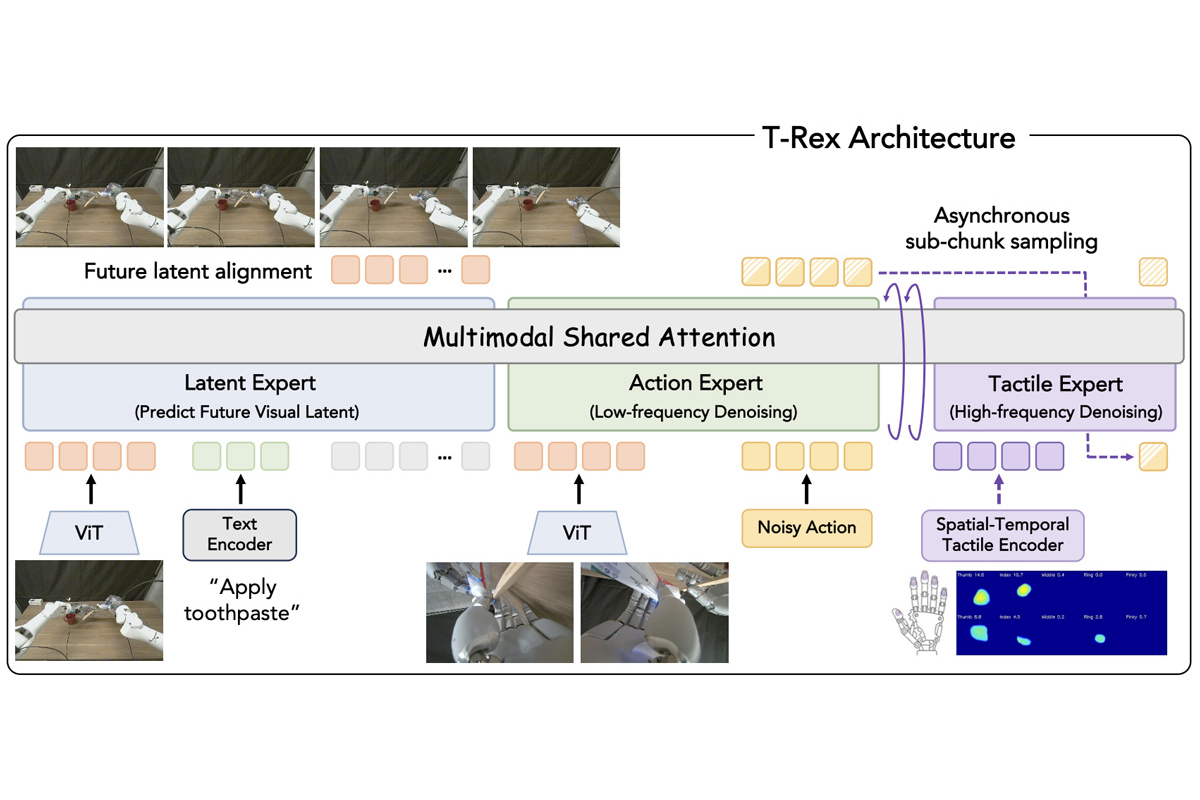
T-Rex combines vision- and language-based action generation with high-speed correction driven by fingertip tactile feedback. Its motion-generation module operates at approximately 5 Hz, while the tactile action-correction module responds to contact conditions at approximately 20 Hz, allowing it to adjust for slippage or excessive pressing without rerunning image recognition.
The research team collected more than 7,700 episodes, totaling 100 hours of bimanual robot manipulation data, using more than 200 types of everyday objects and 22 types of basic actions. The data synchronizes video from head and wrist cameras, robot states and actions, force and deformation information from tactile sensors on 10 fingertips, and natural-language instructions. T-Rex learns visual and motion knowledge from 22,889 hours of human egocentric video, then learns contact-rich robot behaviors from the tactile-annotated data before fine-tuning with approximately 100 demonstrations per task.
Across tasks including turning pages, transferring eggs, applying toothpaste, unlocking with a key, pulling out a card and screwing in a light bulb, T-Rex achieved a 65% average success rate, compared with 35% for the previously best-performing baseline. Without tactile information, its average success rate fell to 42%. Panasonic describes the result as state-of-the-art performance.
The research involves Panasonic R&D Company of America, the University of California, Berkeley, NVIDIA, Stanford University, Sapienza University of Rome and ItalAI. The team will present the results at the Conference on Robot Learning in Austin, United States, November 9-12, 2026. Panasonic says it aims to apply the technology to manufacturing tasks requiring fine force control and to handling soft or fragile items in logistics.