

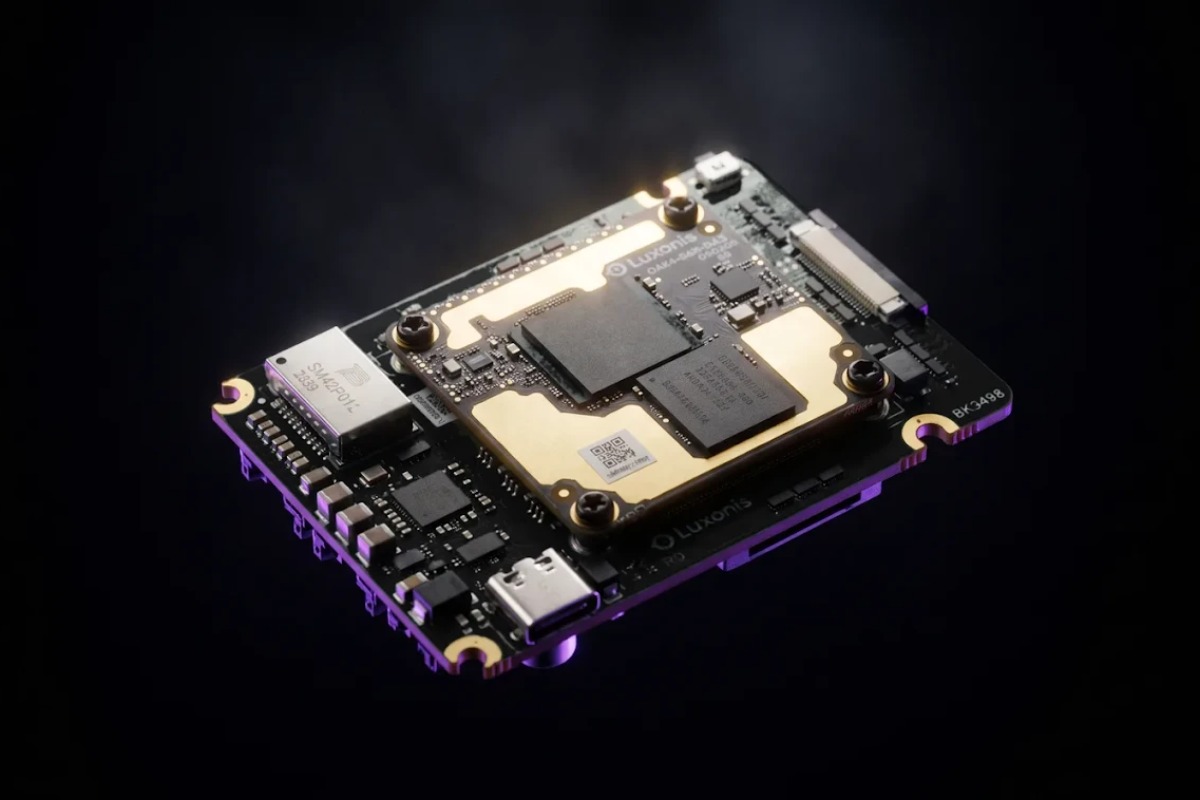
Luxonis today released the OAK 4 FFC, the first OAK Modular device built on OAK 4. It is a board-level vision computer for humanoids, drones, and other machines that a standard camera does not fit. Builders connect up to five Luxonis camera modules in the positions and spacing their design requires. The board handles synchronization, calibration, stereo depth, and AI on its 6-core RVC4 processor with 52 total TOPS of compute.
A custom multi-camera rig typically requires sourcing compute, a carrier board, cameras, and drivers from different vendors, followed by development of synchronization and calibration tools. With OAK 4 FFC, the camera modules, compute, firmware, DepthAI SDK, and OAK Viewer come from one platform and are designed to work together.

Teams select from nine modules across three sensors: the 48 MP IMX586 color sensor, and the 1 MP OV9282 and 5 MP OG05 global shutter sensors, available in standard and wide fields of view. Builders set their own stereo baselines and viewpoints. A humanoid head, for example, can carry a forward stereo pair at human eye spacing plus side and rear cameras, all on a single board. Thermal, Time-of-Flight (ToF), and additional global shutter modules are coming soon. Teams can contact Luxonis at sales@luxonis.com for details or prototype access.
Each module ships with factory-calibrated intrinsics stored on the module. Users enter camera positions in OAK Viewer, and Luxonis Dynamic Calibration refines the alignment of cameras with overlapping views using ordinary scene texture. This produces stereo pairs at the chosen baseline for depth, or panoramic and bird’s-eye views stitched from overlapping cameras.
On a stationary system or simpler robot, OAK 4 FFC can serve as the main computer. It runs the Linux-based Luxonis OS, allowing the camera pipeline, AI models, and application logic to operate on the board. On a more complex robot, it functions as a dedicated perception system that processes camera data on-device and sends results such as depth, detections, and tracked objects to the robot’s main computer. The board provides 2.5 Gigabit Ethernet, PoE+ through the PoE module included in the Developer Kit, 6-32 V DC input, USB-C, CAN, and hardware frame sync.
Bradley Dillon, CEO of Luxonis, stated: “The machines our customers are building, from humanoids and drones to surgical and mobile robots, don’t have room for a camera designed for someone else’s machine. They kept asking for the same thing: let us choose the sensors and where they go, and you handle the hard parts underneath. With OAK Modular now on OAK 4, a team can design its vision system around its robot, instead of its robot around a camera.”
The Developer Kit and the 36 g Barebone share the same vision core and run the same application. The Developer Kit includes a heatsink, bracket, PoE+ module, and connectors. The Barebone is intended for integration into a customer’s own enclosure with their own cooling and power. Luxonis is releasing the OAK 4 FFC reference design as open source so teams can build their own carrier board around the OAK 4 SoM.
Orders are open for the OAK 4 FFC Developer Kit at $849 and the OAK 4 FFC Barebone at $729. Both prices include a temporary $200 surcharge for memory and storage. Camera modules are sold separately starting at $39.99. Developer Kit orders begin shipping in November, and Barebone deliveries are scheduled for Q1 2027. More information is available at www.luxonis.com/oak4-ffc.