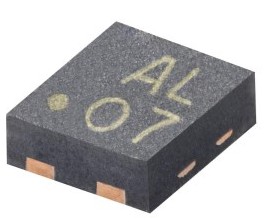
Murata has commenced mass production of its MRMS166R and MRMS168R anisotropic magnetoresistance (AMR) sensors targeted at healthcare, wearable, and IoT devices.
The MRMS166R is the first AMR sensor to combine an average current consumption of 20 nA with operation from a 1.2 V supply. Both sensors function as solid-state magnetic switches that detect the presence or absence of a magnetic field and generate an output signal used by system logic to control transitions between active and sleep modes. This enables contactless switching without mechanical components.

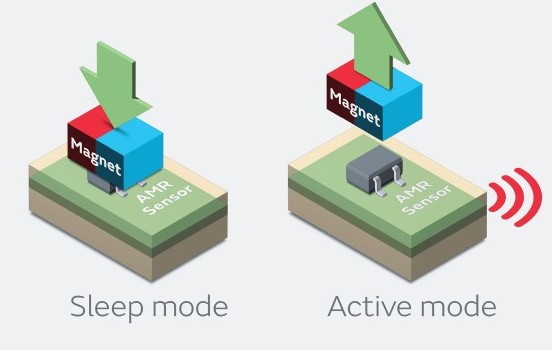
Automatic switching between active and sleep modes is used in battery-powered devices to reduce standby power consumption and extend operating life. Target applications include capsule endoscopes and medical patches in healthcare, AR glasses and wireless earbuds in wearables, and door open/close detection systems and smart locks in security-related IoT devices.
These devices often use silver oxide coin batteries with a typical voltage of 1.55 V, which limit both capacity and operating voltage. The sensors were developed through a redesign of the AMR sensor’s internal circuitry to achieve ultra-low current consumption and reliable operation at low voltages.

The MRMS166R operates over a supply voltage range of 1.2 to 3.6 V (1.5 V typical), with an average current consumption of 20 nA and a maximum output current of 1 mA. The MRMS168R operates over a supply voltage range of 2.0 to 3.6 V (3.0 V typical), with an average current consumption of 80 nA and a maximum output current of 12 mA.
Both sensors are housed in a compact package measuring 1.0 × 1.0 × 0.4 mm. The low current consumption during standby operation is designed to support device operation for more than two years in typical use with coin cell batteries.
Murata will continue to expand its AMR sensor lineup and reduce power consumption to support longer operating times in medical, wearable, and IoT devices.