
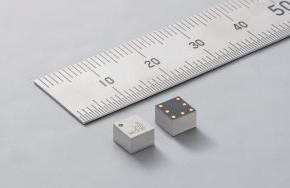
Murata announced the PKGM-210D-R, an SMD-type vibration sensor device capable of detecting vibrations in the high-frequency range up to 20 kHz. Mass production of the device has begun.
In factory automation, maintenance has traditionally involved scheduled intervals or corrective actions after failures. Predictive maintenance, which identifies early signs of failure to prevent unexpected equipment stoppages, has gained importance. In rotary machinery such as bearings and motors, component damage or insufficient lubrication produces minute abnormal vibrations in the high-frequency range up to 20 kHz before serious issues develop. Detection of these vibrations has been difficult due to noise interference and has often depended on skilled technicians using auditory inspection.

The PKGM-210D-R combines Murata’s piezoelectric ceramic vibration detection technology with advanced circuit packaging to enable detection of vibrations up to 20 kHz, the upper limit of the audible range. This allows identification of subtle high-frequency abnormal vibrations previously detectable only by human hearing.
The device supports early prediction of equipment issues, which can reduce downtime, optimize maintenance timing, extend component life, and minimize excess inventory. Its compact size of 5.0 × 5.0 × 3.5 mm (0.20 × 0.20 × 0.14 inches) facilitates retrofitting to existing equipment or integration into motor components.

Key features include:
Z-axis detection up to 20 kHz
Compact size for easy retrofit and built-in mounting
Built-in driver and filter circuits
Versatile single analog output
Built-in temperature sensor
Specifications:
Product name: PKGM-210D-R
Size (L × W × T): 5.0 × 5.0 × 3.5 mm (0.20 × 0.20 × 0.14 inches)
Detection axes: 1 (Z direction)
Detection G range (min.): ±10.2 G (typical: ±50 G)
Frequency bandwidth: 5 - 20 kHz
Supply voltage: 3.0 - 5.2 V
G sensitivity (typ.): 44 mV/G
Current consumption: 3.0 mA
Output type: Single analog output
Operating temperature range: -20°C to 85°C