

Kioxia and Kyocera announced the successful development of a prototype PCIe 5.0-compatible broadband SSD with an optical interface. This innovative broadband optical SSD is designed to meet the demands of advanced applications requiring high-speed data transfer, such as generative AI, and is set to undergo proof-of-concept tests for future social implementation.
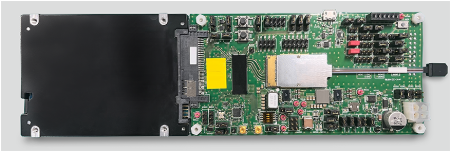
The new prototype leverages the high-speed PCIe 5.0 interface, which offers twice the bandwidth of the previous PCIe 4.0 generation. This achievement is made possible through the integration of AIO Core's IOCore optical transceiver and Kyocera's OPTINITY optoelectronic integration module technologies. The PCIe 5.0 interface significantly boosts data transfer speeds, facilitating the rapid processing of large datasets essential for AI and other advanced applications.
ADVERTISEMENT

By replacing traditional electrical wiring with optical interfaces, the broadband optical SSD enhances energy efficiency, contributing to the development of next-generation green data centers. Additionally, the optical interface allows for greater physical separation between compute and storage devices without compromising signal quality, offering more flexibility in data center design. This technology supports the complex, high-volume, and high-speed data processing required by evolving digital applications and generative AI.
The PCIe 5.0-compatible broadband optical SSD is particularly suited for applications that demand high-speed data transfer and processing. These include facilitating the rapid processing and transfer of large datasets required for training and deploying AI models in generative AI, enhancing the efficiency of data analysis by enabling faster access to large volumes of data in big data analytics, supporting complex computations and simulations that require high-speed data transfer in high-performance computing , improving the performance and scalability of cloud-based services by providing faster data access and transfer in cloud computing, and contributing to the design of energy-efficient, high-performance data centers that can handle the demands of modern digital applications.
ADVERTISEMENT

This development is part of the Japanese "Next Generation Green Data Center Technology Development" project (JPNP21029), subsidized by the New Energy and Industrial Technology Development Organization (NEDO) under the "Green Innovation Fund Project: Construction of Next Generation Digital Infrastructure." The project aims to achieve more than 40% energy savings compared to current data centers.
For more information, Visit https://global.kyocera.com