
Research fabs at IISc, a ₹200-crore fund of funds, the government as first customer, and a semiconductor accelerator signing industry partners. BTS 2026 showed how the Government of Karnataka is building the ESDM stack layer by layer.
Karnataka's approach to electronics and semiconductors is not a single policy but a layered toolkit. It combines incentives for large manufacturing investments, research infrastructure for early-stage technology, capital for startups and skilling for the workforce. BTS 2026 added new pieces to almost every layer.
The foundation is the state's ESDM policy framework, which runs from 2023 to 2030 on two tracks: a broad ESDM policy for new and smaller firms, and a Special Incentive Scheme for large electronics and semiconductor investments. The framework rewards local sourcing, with required value addition rising from 25% in a company's first year to 45% by its fifth. Officials have also signalled a revised electronics policy with a dedicated semiconductor focus. Large projects are already moving under this umbrella. In May 2025, a cabinet sub-committee cleared incentives for three semiconductor projects, from Applied Materials, Lam Research and Bharat Semi Systems, worth about ₹23,000 crore combined. A year later, in May 2026, the cabinet allotted 140 acres in a Bengaluru business park to Applied Materials. Commenting on the March 2026 state budget, the industry body IESA said the state expects nearly ₹45,000 crore of semiconductor and ESDM investment, while four electronics manufacturing clusters stretching from Dharwad to Mysuru are being built with ready land, power and talent.
The summit's most significant additions came in research infrastructure. The state announced backing for two national semiconductor facilities at IISc, a robotics and AI zone, an AI hub and a health-technology centre, set out below.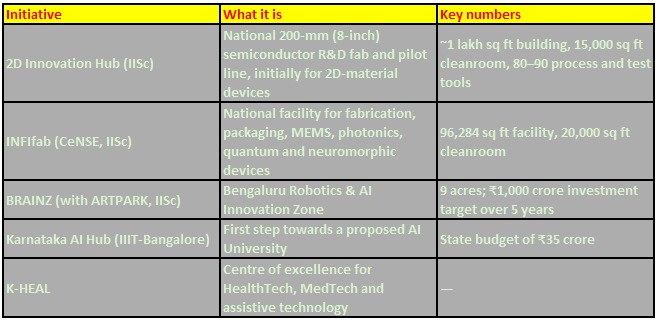
Research facilities need startups to use them, and the third layer of the playbook is capital. At an IVCA roundtable chaired by IT/BT Minister Priyank Kharge, the government committed ₹200 crore to a fund of funds and set a target of drawing ₹500 crore more from private investors. The ELEVATE NxT programme offers equity-free grants of up to ₹1 crore to deep-tech startups, with 33 ventures selected this year. Innoverse will support 35 growth-stage deep-tech ventures over five years as they move from validated product to scale. Most unusually, the Government First initiative makes the state a startup's first paying customer. Eight startups received work orders of up to ₹25 lakh each, four to work with Praja Seva on citizen services and four with BWSSB on water management, and the stated target is 100 startups.
Chip startups also gained a dedicated support network. The Semiconductor Future Accelerator Lab (SFAL), backed by the state, signed two MoUs at the summit. The first, with IAN Group, offers funding of ₹50 lakh to ₹50 crore along with mentorship and global market access. The second, with Anritsu India, brings test-and-measurement expertise to startups that cannot afford their own labs. Panellists also asked for patent reimbursements and faster processes so startups can keep the value of their IP.
The final layer is talent. The state announced AI skilling for 63,200 students and professionals with Google, Salesforce, Pega Systems, Sarvam AI and Gnani.ai. The ₹300 crore Nipuna Karnataka mission has already made more than 33,000 people industry-ready. The Namma AI Hackathon, run by Arm and IIIT Bangalore with NASSCOM and UK government support, drew more than 2,700 registrations for on-device edge-AI projects.
Industry voices were equally clear about what is still missing. Chip startups need more patient, follow-on capital beyond seed and Series A. Imports of specialised research equipment take too long to clear customs. And startups need access to existing labs at IISc, RRI and JNCASR while the new facilities are built. At the Karnataka Quantum Mission roundtable, Rahul Kulshresth proposed a single-window customs desk in Bengaluru for research equipment. How quickly the state acts on requests like these will decide whether its policy layers become a working ecosystem.