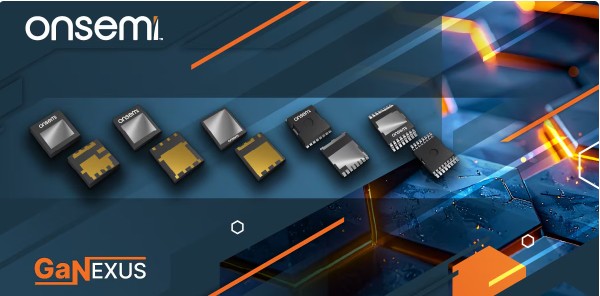
onsemi has announced the launch of its GaNEXUS gallium nitride (GaN) power portfolio. The initial devices, now sampling, include GaNEXUS FETs across voltage ranges from 40V to 650V and 650V GaNEXUS Smart GaN FETs with integrated protection features.
The portfolio targets applications in AI data centers, robotics, industrial automation, and energy infrastructure. GaNEXUS devices are designed for faster switching speeds, lower switching losses, higher power density, and improved thermal performance.

When combined with onsemi’s Treo Platform for integrated sensing, control, protection, and power management, GaNEXUS enables system-level power solutions. Together with onsemi’s silicon and EliteSiC technologies, the portfolio provides options to optimize efficiency, thermal performance, system size, and total cost across the power-delivery chain.
In low- and medium-voltage systems such as AI server 48V intermediate bus converters, battery backup units, and motor drives, GaNEXUS enables approximately 30–60% smaller magnetics, 1.5x–2x higher power density, 0.5–2% efficiency improvement depending on topology, reduced switching losses, and improved thermal performance and control stability.

In higher-voltage applications including AI power shelves, high-voltage DC-DC conversion, power factor correction (PFC), and LLC power stages, the portfolio supports up to approximately 60% reduction in magnetics size in high-frequency AC-DC and resonant stages, 1.5x–2x higher power density in PFC, LLC, and HV DC-DC architectures, 0.5–1% efficiency gains, and lower losses that reduce thermal stress.
GaNEXUS Smart devices reduce system risk and simplify power stage design. The FETs use thermally enhanced packages with industry-standard footprints for dual sourcing, including TOLL Bottom Cooling, TOLT Top Cooling, and dual cooling 3.3mm x 3.3mm and 5mm x 6mm packages.
Antoine Jalabert, vice president of the GaN division at onsemi, said the GaNEXUS portfolio enables new architectures for power system design and provides engineers with greater flexibility as customers seek more power in less space.