Synopsys, is presenting the outcomes of its strategic partnership with NVIDIA at NVIDIA GTC 2026, focusing on integrations of NVIDIA AI and accelerated computing with Synopsys engineering solutions for design, simulation, and verification across semiconductor, aerospace, automotive, and industrial sectors.
Synopsys is developing an open, secure, hardware-accelerated agentic AI stack with NVIDIA for applications from silicon to systems. This includes Synopsys AgentEngineer multi-agent workflows that use the NVIDIA Agent Toolkit, NVIDIA NIM inference services, and Nemotron models. Demonstrations at GTC feature agentic EDA workflows, including a new L4 agentic workflow for design and verification, to orchestrate complex chip design tasks while maintaining engineer oversight.
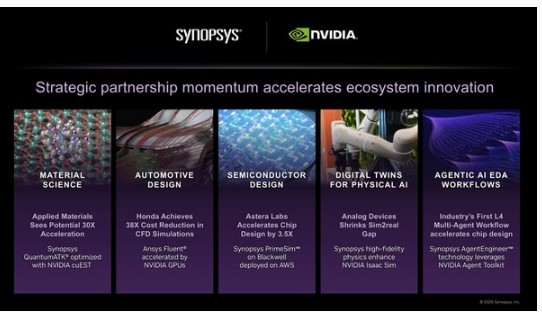
Customer examples include:
Applied Materials collaborates with Synopsys and NVIDIA on quantum chemistry simulations using Synopsys QuantumATK integrated with NVIDIA cuEST, achieving up to 30X speedup for complex workloads compared to open-source CPU models. Earlier results showed 8X speedup with NVIDIA GPUs for multi-nanometer amorphous systems with approximately 25,000 atoms.
Honda uses Ansys Fluent on NVIDIA GB200 GPUs, realizing 34X faster computation and 38X cost reduction with four GB200s compared to 1,920 cloud-based CPU cores for unsteady, large-scale, high-fidelity CFD simulations.
Astera Labs runs Synopsys PrimeSim on AWS with NVIDIA B200 GPUs, obtaining 3.5X speedup over multi-core CPU simulations for advanced chip design in AI connectivity, reducing design validation cycles.
Analog Devices (ADI) integrates Synopsys physics into NVIDIA Isaac Sim for high-fidelity simulations of tactile sensing, time-of-flight vision systems, and robotic dexterity benchmarks. This supports digital twins and synthetic data generation for applications in datacenters and automotive manufacturing, with demonstrations including a bi-manual robotic arm setup. Early adopters such as Kawasaki Heavy Industries can use the platform to reduce physical testing iterations.
Sassine Ghazi, president and CEO of Synopsys, stated that traditional engineering methods cannot match the complexity of software-defined intelligent systems, and the collaboration enables co-design of electronics and multiphysics, accelerated workloads, and digital twin prototyping.
Jensen Huang, founder and CEO of NVIDIA, noted that modern engineering occurs in simulations and digital twins, combining NVIDIA CUDA-X, Omniverse, and AI with Synopsys platforms to address complexity.
Synopsys sessions at GTC 2026 include:
"Reducing the Sim2Real Gap for Industrial Robotics" by Srinivasa Mohan on March 16 at 3:00 p.m. in SJCC Grand Ballroom Theater (L2).
"Shaping the Future of Semiconductor Manufacturing With AI" by Shankar Krishnamoorthy on March 17 at 10:00 a.m. in SJCC 211AC (L2).
"Accelerating Quantum Chemistry on GPUs—Latest Advances" with Anders Blom on March 17 at 4:00 p.m. in SJCC LL21E (LL).
"How Simulation and AI are Giving Life to Digital Twins for Patient Care" by Dr. Mark Palmer on March 18 at 11:00 a.m. in SJCC LL21AB (LL).
"Interactive CFD at the Cutting Edge: Experiencing Digital Twins and Urban Simulation with Omniverse" by Akira Fujii on March 18 at 6:00 p.m. (virtual).
Synopsys is exhibiting at booth #1135 for demonstrations and discussions.