
Panasonic Corporation announced on March 4, 2026, in Osaka, Japan, that its Heating & Ventilation A/C Company has begun accepting orders in the European market for two models of Coolant Distribution Units (CDUs) and two models of free-cooling chillers designed for generative AI data centers. The CDUs are available in 400 kW and 800 kW capacities, with order acceptance for models of 1,200 kW and above scheduled to start within March 2026. The free-cooling chillers are offered in 800 kW and 1,200 kW models.
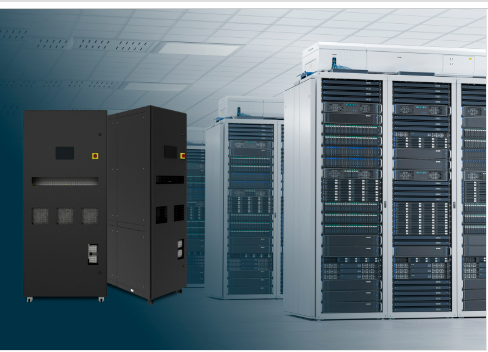
The CDUs perform heat exchange and distribute coolant using chilled water supplied by chillers. They complement traditional air-cooling systems, enabling hybrid configurations that combine air-cooling for entire rooms with liquid cooling for high-heat-density zones. This approach achieves power savings and reduces the overall system footprint for equivalent cooling capacity, supporting space optimization in data centers.
The free-cooling chillers are Panasonic's first chillers developed for data centers and target small to medium-scale facilities such as edge data centers. They use low outdoor temperatures (up to 10°C) to generate chilled water for high energy efficiency and employ the low-GWP refrigerant R1234ze(E) with a GWP of 1 to reduce environmental impact.
Panasonic acquired Tecnair S.p.A., an Italy-based manufacturer of Close Control Air-Conditioning Units (CCUs) for air-cooling, in 2023. This acquisition supported the expansion of its data center cooling business in Europe. The addition of CDUs extends its portfolio to include high-efficiency liquid cooling solutions.
The systems address the increasing heat output from high-performance GPU chips in generative AI data centers, where air-cooling faces limitations due to rising thermal loads. Liquid cooling meets the need for stable operation, performance maintenance, and reduced electrical load in hyperscalers and colocation data centers.