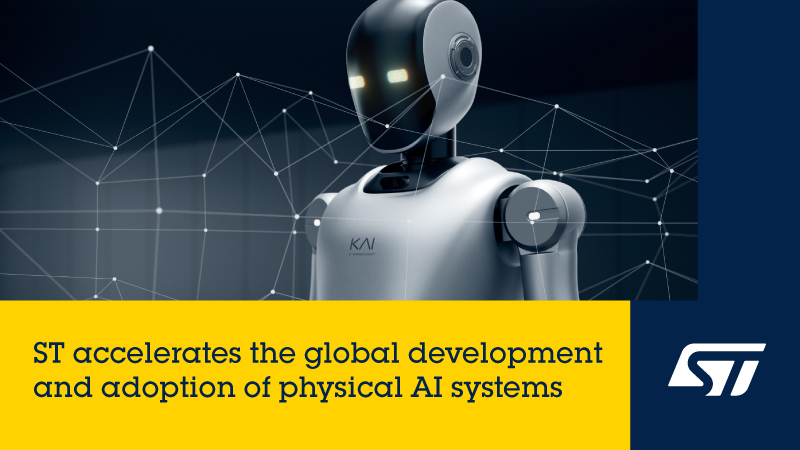
STMicroelectronics announced a partnership with NVIDIA to integrate its sensors, STM32 microcontrollers, and motor control solutions into the NVIDIA robotics ecosystem. The collaboration targets the development, training, and deployment of physical AI systems, including humanoid robots, industrial robots, service robots, and healthcare robots. STMicroelectronics is incorporating its robotics portfolio into the reference components compatible with the NVIDIA Holoscan Sensor Bridge (HSB). At the same time, high-fidelity models of ST components are being added to the NVIDIA Isaac Sim ecosystem to support more accurate sim-to-real transitions in research and development.
Initial deliverables now available to developers include the integration of Leopard Imaging’s stereo depth camera enabled by ST imaging, depth, and motion-sensing technologies with the NVIDIA Holoscan Sensor Bridge, along with a high-fidelity model of an ST inertial measurement unit (IMU) incorporated into NVIDIA Isaac Sim. The NVIDIA Holoscan Sensor Bridge enables developers to unify, standardize, synchronize, and streamline data acquisition and logging from multiple ST sensors and actuators. This capability serves as a foundation for creating high-fidelity Isaac Sim models, accelerating learning processes, and reducing differences between simulation and real-world performance.
The integration aims to simplify connections between ST sensors and actuators and NVIDIA Jetson platforms. Pre-integrated solutions combine STM32 MCUs, advanced sensors such as IMUs, imagers, and time-of-flight (ToF) devices, and motor control solutions, with particular relevance for humanoid robot designs. The Leopard Imaging stereo depth camera is cited as an example expected to support designs by physical AI OEMs, academic research groups, and the industrial robotics community.
Advanced robotics development involves high costs and modeling difficulties, including the resource demands of high-fidelity simulations with extensive randomization, the need for large datasets, and the expertise required to select appropriate randomization parameters. Incorrect choices can lead to unrealistic scenarios, inefficient training, model confusion, slower convergence, or degraded real-world performance.
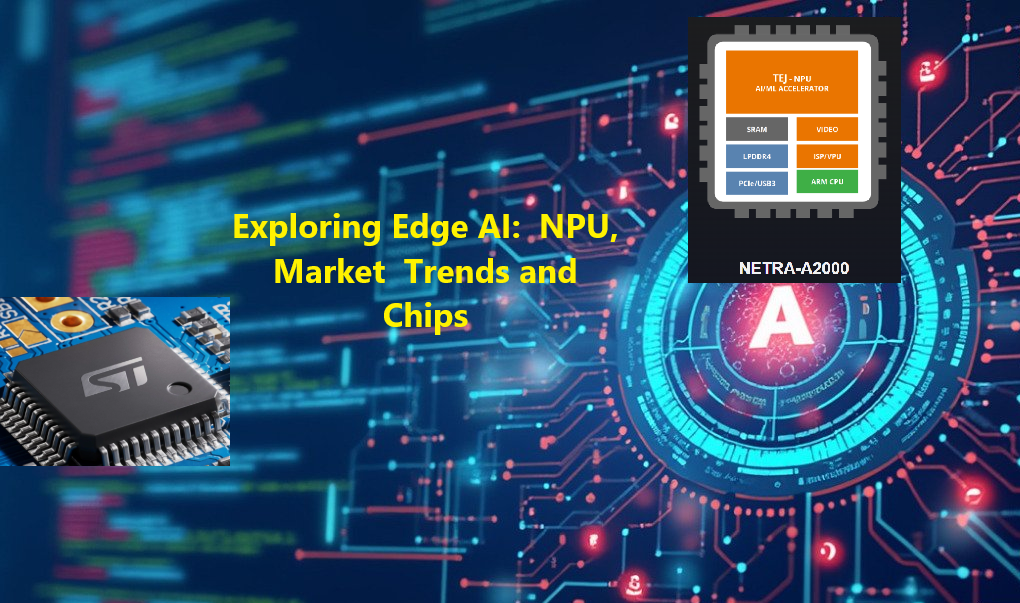
ST and NVIDIA are working to deliver accurate, hardware-calibrated models for ST’s component portfolio tailored to advanced robotics requirements. Following the release of the initial IMU model, additional models for ToF sensors, actuators, and other ICs are in development. These models are derived from benchmark data collected on real ST hardware using ST tools to ensure realistic behavior, with optimization for the NVIDIA Isaac Sim ecosystem. The NVIDIA Holoscan Sensor Bridge is also being integrated into ST’s toolchain.
The companies state that more accurate models will enable robots to learn from simulations that better match real-world conditions, resulting in shorter training cycles and reduced costs for developing and refining humanoid robotics applications. Rino Peruzzi, Executive Vice President, Sales & Marketing, Americas & Global Key Account Organization at STMicroelectronics, said the collaboration streamlines the developer and customer experience from AI algorithm inception to sensor and actuator integration. Deepu Talla, Vice President of Robotics and Edge AI at NVIDIA, stated that combining ST’s sensor and actuator technologies with NVIDIA Isaac Sim, Holoscan Sensor Bridge, and Jetson platforms provides a unified foundation for building, simulating, and deploying physical AI at scale.
Additional information on the NVIDIA Holoscan Sensor Bridge and ST solutions for physical AI development with NVIDIA is available on their respective websites.