
Sampige Semiconductors, a fabless semiconductor company based in India, has signed a Memorandum of Understanding (MoU) with BharatGen Technology Foundation to collaborate on the development of India-centric AI semiconductor chipsets, hardware-aware models, and a unified software stack.
The company, founded by Parag Naik, focuses on designing chipsets for consumer electronics, IoT infrastructure, and AI applications to reduce reliance on imported silicon. Its target markets include custom silicon for mobile handsets, smart TVs, set-top boxes, and connected devices in consumer electronics; purpose-built SoCs for smart metering, industrial automation, and connected infrastructure in IoT; and AI chipsets for training and inference to support sovereign AI efforts.
The MoU aligns with the Make in India initiative and aims to address affordability, linguistic diversity, and applications in sectors such as agriculture, healthcare, and telecom. The partnership involves co-development of next-generation AI semiconductor chipsets, energy-efficient hardware architectures, optimized hardware design, comprehensive AI model research, and a unified AI software stack including compilers and kernel orchestration.
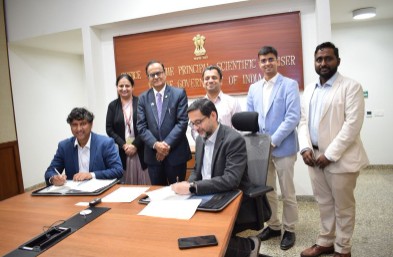
Parag Naik shared details of the agreement on LinkedIn, including a photograph of the signing. The MoU was signed in the presence of Principal Scientific Advisor to the Government of India Dr. Ajay Kumar Sood and Scientific Secretary Dr. Parvinder Maini. Also present were Rishi Bal, CEO of BharatGen Technology Foundation; Prof. Ganesh Ramakrishnan, Founding Board member of BharatGen and Institute Chair Professor at the Department of Computer Science and Engineering, Indian Institute of Technology Bombay; Prof. Priyesh Shukla from IIIT Hyderabad; and Pankaj Singh, Vice President of BharatGen, along with other consortium members.
Naik noted the company's name derives from the Sampige flower (Magnolia Champaca), native to Karnataka and symbolizing growth. He referenced his prior entrepreneurial experience, including founding Smart Yantra in 1999, and highlighted the current opportunities in India's hardware ecosystem compared to 25 years ago.
The collaboration seeks to establish a locally-rooted AI ecosystem by reducing dependency on foreign AI infrastructure through indigenous hardware and models tailored to Indian requirements.