

Essential skills for a successful VLSI chip design engineering career
Becoming a VLSI (Very Large Scale Integration) semiconductor chip design engineer is both a well-paid and satisfying career path that combines deep technical knowledge with innovative problem-solving. If you're aspiring to excel in this field, here's a rundown of the essential skills you'll need other than the strong theortical fundamentals you gained in your graduation course.
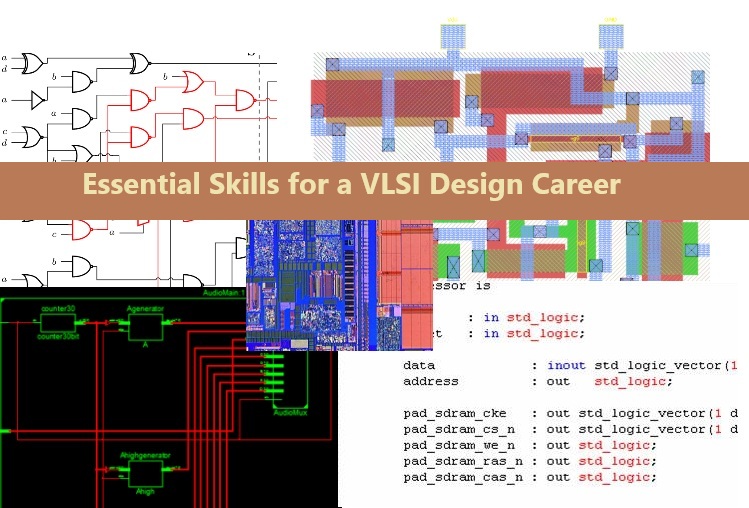
Technical Knowledge and Expertise
Digital Design: Master digital circuits using hardware description languages (HDLs) like VHDL or Verilog.
Analog Design: Grasp the principles and techniques of analog circuit design.
Mixed-Signal Design: Learn to integrate both analog and digital circuits on a single chip.
EDA Tools Proficiency
Get familiar with Electronic Design Automation (EDA) tools such as Cadence, Synopsys, and Mentor Graphics for simulation, synthesis, place-and-route, and verification.
Circuit Simulation and Modeling
Use simulation tools (e.g., SPICE) to model and analyze circuit behavior under various conditions.
Layout Design
Understand layout design principles and gain experience with layout tools to create physical representations of circuits.
Verification and Testing
Learn verification techniques, including functional verification, forma...