
UK based Neuranics has successfully raised $8 million in seed funding to accelerate the global growth and commercial adoption of its pioneering Tunnelling Magnetoresistance magnetic sensing technology.
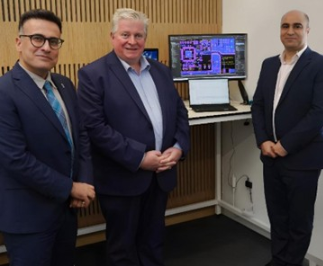
Image: (L–R): Neuranics CTO Hadi Heidari, CEO Noel McKenna, and CSO Kia Nazarpour
ADVERTISEMENT

The investment round was led by Blackfinch Ventures, with participation from Archangels, and continued support from Par Equity, the University of Glasgow, and Old College Capital, the University of Edinburgh’s venture investment fund. This funding will drive Neuranics’ next phase of development, including team expansion, technological innovation, and the integration of its TMR technology into emerging high-tech markets such as XR, wearables, and digital health.
Neuranics’ ultra-sensitive, low-power, and scalable sensors are designed to detect tiny magnetic signals from the human body, enabling precise tracking of muscle activity for gesture recognition and heart signals all without skin contact. Compared to traditional methods, Neuranics’ magnetic sensing technology offers improved accuracy, reduced power consumption, and the potential for continuous monitoring. These advantages position Neuranics’ technology as a breakthrough for next-generation XR hardware and wearable technology.
TMR is a magnetoresistive effect that occurs in a magnetic tunnel junction , which consists of two ferromagnets separated by a thin insulator. When the insulating layer is thin enough (typically a few nanometers), electrons can tunnel from one ferromagnet into the other. This quantum mechanical phenomenon allows for the detection of magnetic fields with high sensitivity and low power consumption.
The MTJ element in TMR sensors is a multilayer, thin-film stack composed of a free layer, a spacer layer, and a pinned layer. The spacer layer, often made of magnesium oxide (MgO), enables high tunnelling magnetoresistance ratios, significantly enhancing the sensor's performance. TMR sensors are known for their superior performance in power consumption, sensitivity, and accuracy compared to other magnetic sensing technologies such as Hall effect sensors.
TMR is a magnetoresistive effect that occurs in a magnetic tunnel junction , which consists of two ferromagnets separated by a thin insulator. When the insulating layer is thin enough (typically a few nanometers), electrons can tunnel from one ferromagnet into the other. This quantum mechanical phenomenon allows for the detection of magnetic fields with high sensitivity and low power consumption.
The MTJ element in TMR sensors is a multilayer, thin-film stack composed of a free layer, a spacer layer, and a pinned layer. The spacer layer, often made of magnesium oxide (MgO), enables high tunnelling magnetoresistance ratios, significantly enhancing the sensor's performance. TMR sensors are known for their superior performance in power consumption, sensitivity, and accuracy compared to other magnetic sensing technologies such as Hall effect sensors.
CEO Noel McKenna commented, “This investment marks a significant step forward as we continue pioneering new applications for magnetic sensing. With the support of our investors, we are expanding our team, advancing our technology, and bringing our solutions closer to widespread adoption.”
ADVERTISEMENT

For more information, Please visit https://neuranics.com/