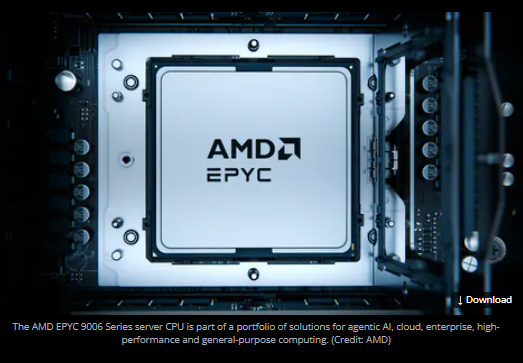
Agentic systems link multiple CPU roles into a single workflow. The current AMD EPYC generation allows optimization for individual tasks while maintaining future flexibility. The AMD EPYC 9006 Series server CPU belongs to a broader portfolio covering agentic AI, cloud, enterprise, high-performance computing and general-purpose workloads.
Two years earlier, AI infrastructure planning focused mainly on training capacity. Inference later became the primary driver of requirements. Agents now convert one request into a changing sequence of retrieval, tool calls, code execution and result generation. This produces a variable workflow that alters both the volume of compute needed and its location with each run.
Systems designed for a fixed moment risk mismatch with later demands. Flexibility therefore applies at every stack layer, including the CPUs that support the agentic pipeline.
Enterprises already operate with this reality. Databases, virtualization, analytics, web services, technical computing and AI have long called for distinct system profiles. Agentic AI incorporates several of those profiles inside one continuous process.

An AMD white paper therefore examines 6th Gen AMD EPYC 9006 “Venice” server CPUs across general-purpose, enterprise, cloud-native, AI and high-performance computing workloads instead of a narrow subset.
SPECrate 2026 Integer results show the AMD EPYC 9996 server CPU reaching 1.2 times the per-core performance of an Nvidia Vera-based platform and 2.24 times the platform-level performance. In enterprise and cloud-native tests that include server-side Java, OpenSSL, MongoDB, Redis, NGINX and transaction processing, reported gains range from 2.4x to 3.7x.
Compared with the Intel Xeon 6980P processor, the AMD EPYC 9996 records advantages of 1.8x to 3.13x in molecular dynamics, materials modeling and weather forecasting. A modeled 100-kilowatt rack yields an estimated 3.4 times the throughput of a Vera-based platform.
Higher loaded per-core performance can reduce latency on time-sensitive tasks, while greater core density can increase concurrent capacity and rack-level output. A multi-family processor range enables separate optimization of both factors without forcing a uniform trade-off across an entire fleet.
“Venice” forms one element of that range: four families that share a common software base and extend from 8-core edge systems through 256-core flagship processors to rack-scale AI host nodes. Each stage of an agentic pipeline can therefore select the matching processor profile without introducing a separate operating environment.
“Venice” is already in production. Major OEM platforms are scheduled to appear, and leading cloud providers plan to begin deployment later this year.
Agentic AI continues to increase workload variety. Greater diversity of compute requirements has historically been met by greater choice rather than reduced options.