
India's medical device industry is projected to reach a market size of $250 billion by 2047, according to the FICCI-DUA Consulting White Paper on ‘Service and Maintenance of Medical Equipment in Indian Healthcare – Towards a Safe, Reliable and Sustainable Medical Device Maintenance Ecosystem’.
The White Paper, released during the inaugural session of the 9th edition of ‘India Medical Device 2026’, organised by the Department of Pharmaceuticals in association with FICCI, states that the sector, currently valued at around $14 billion, is projected to reach $30-50 billion within this decade and $250 billion by 2047. Rising healthcare demand, increased adoption of advanced medical technologies, government support for indigenous manufacturing, and the country's ambition to become a global MedTech hub are identified as factors expected to drive the growth.
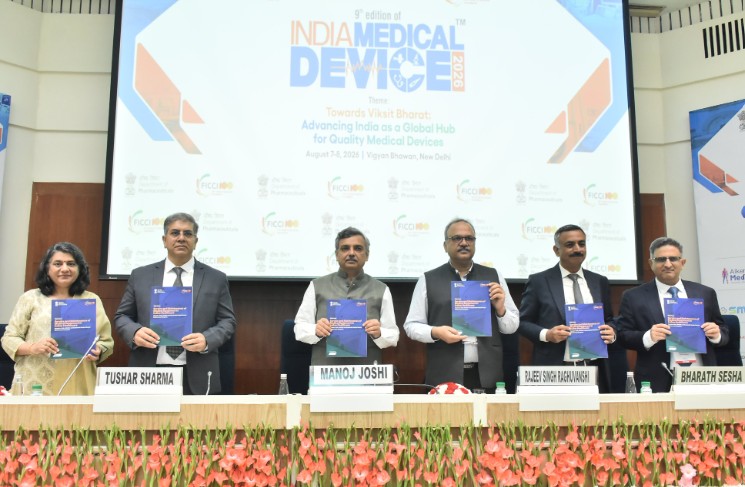
The report notes that India has made progress through the Production Linked Incentive (PLI) Scheme and the Strengthening of Medical Devices Industry Scheme, which have enhanced domestic manufacturing capabilities and improved global competitiveness. It states that sustained growth will depend not only on manufacturing but also on creating an ecosystem for servicing, maintenance, calibration and lifecycle management of medical equipment.

Medical equipment supports timely diagnosis, emergency response, surgeries and advanced treatment. The value of these technologies depends on reliable servicing throughout their operational lifecycle. Proper maintenance improves patient safety, enhances clinical effectiveness, reduces equipment downtime, extends equipment life and optimises healthcare investments.
The White Paper proposes a risk-tiered hybrid maintenance framework anchored in the Central Drugs Standard Control Organisation (CDSCO) device classification system. It recommends maintenance protocols based on device risk categories, creation of a national certification architecture for service engineers, strengthening technical training, encouraging commercial model innovation, and rationalising the fiscal framework to promote compliant maintenance practices. It also advocates wider adoption of digital technologies, including predictive maintenance, digital monitoring and lifecycle management systems, to improve equipment reliability and minimise downtime. The report presents a roadmap for a medical equipment maintenance ecosystem.
Separately, Union Minister of Chemicals & Fertilizers and Health & Family Welfare J. P. Nadda released a knowledge paper on "AI in MedTech: Revolutionizing Healthcare Through Artificial Intelligence" at the same event at Vigyan Bhawan, New Delhi. Jointly developed by Praxis Global Alliance in association with FICCI, the paper examines India's AI-enabled MedTech landscape and outlines strategic actions needed to accelerate responsible AI adoption across healthcare. It explores AI’s role in diagnostics, clinical decision support, operational efficiency and medical device innovation, while identifying the regulatory, policy and ecosystem interventions required for large-scale adoption.
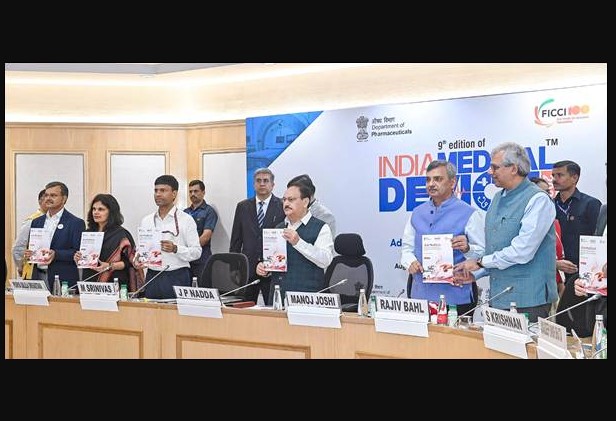
The report notes that India has built foundations through the Ayushman Bharat Digital Mission (ABDM), the IndiaAI Mission, SAHI, BODH and the National Medical Devices Policy, 2023. It observes that moving AI solutions from successful pilots to large-scale clinical adoption remains a major challenge. This transition requires addressing fragmented health data and limited evidence, developing predictable lifecycle-based regulation for adaptive AI, and creating supportive reimbursement and procurement mechanisms. India has an opportunity to leverage its software capabilities, digital public infrastructure, clinical diversity and growing MedTech manufacturing base for the development, manufacturing and deployment of AI-enabled medical technologies.
Manoj Joshi, Secretary, Department of Pharmaceuticals; Dr. M Srinivas, Member, NITI Aayog; Dr Rajiv Bahl, Secretary, Department of Health Research & Director General, ICMR; Smt. Punya Salila Srivastava, Secretary, Department of Health and Family Welfare; Amardeep Singh Bhatia, Secretary, Department of Promotion of Industry & Internal Trade (DPIIT); Sunil Kumar Barnwal, CEO, National Health Authority; Anant Swarup, Secretary General, FICCI; and senior government officials, industry leaders and stakeholders from the MedTech sector were present.
Key insights from the knowledge paper outline five priorities for accelerating AI-enabled MedTech adoption in India:
MedTech represents India's most immediate and scalable AI opportunity, enabling specialist expertise to be embedded directly into medical devices and expanding access to quality healthcare.
India has the foundations for AI leadership, but not yet the ecosystem for scale. While digital infrastructure, innovation and clinician acceptance have advanced rapidly, AI adoption remains constrained by fragmented data, evolving regulation and limited reimbursement pathways.
India must move beyond successful pilots to routine clinical adoption by addressing three ecosystem gaps: AI-ready data and evidence, lifecycle-based regulation, and procurement and reimbursement mechanisms that recognise AI-enabled value.
AI-enabled diagnostics are expected to be the first large-scale application, helping extend specialist expertise to primary and secondary care, improve productivity and reduce inequities in healthcare access.
Coordinated action across government, regulators, healthcare providers, payers, industry and academia will be essential to position India in responsible AI-enabled MedTech.