
Ashling has added support for programming Tenstorrent’s Core Logic Analyzer (CLA) in its RiscFree SDK, giving engineers a graphical way to configure on-chip triggering and trace on Tenstorrent IPs.
RiscFree lets engineers create CLA projects and programs in the IDE. Nodes, event-action pairs (EAPs), events, actions, counters, custom actions, debug bus selection and snapshot signals are configured through dropdowns and autocomplete fields. The SDK generates the CLA program, compiles it to register values, programs the hardware over the existing debug connection and reports the result in the console.

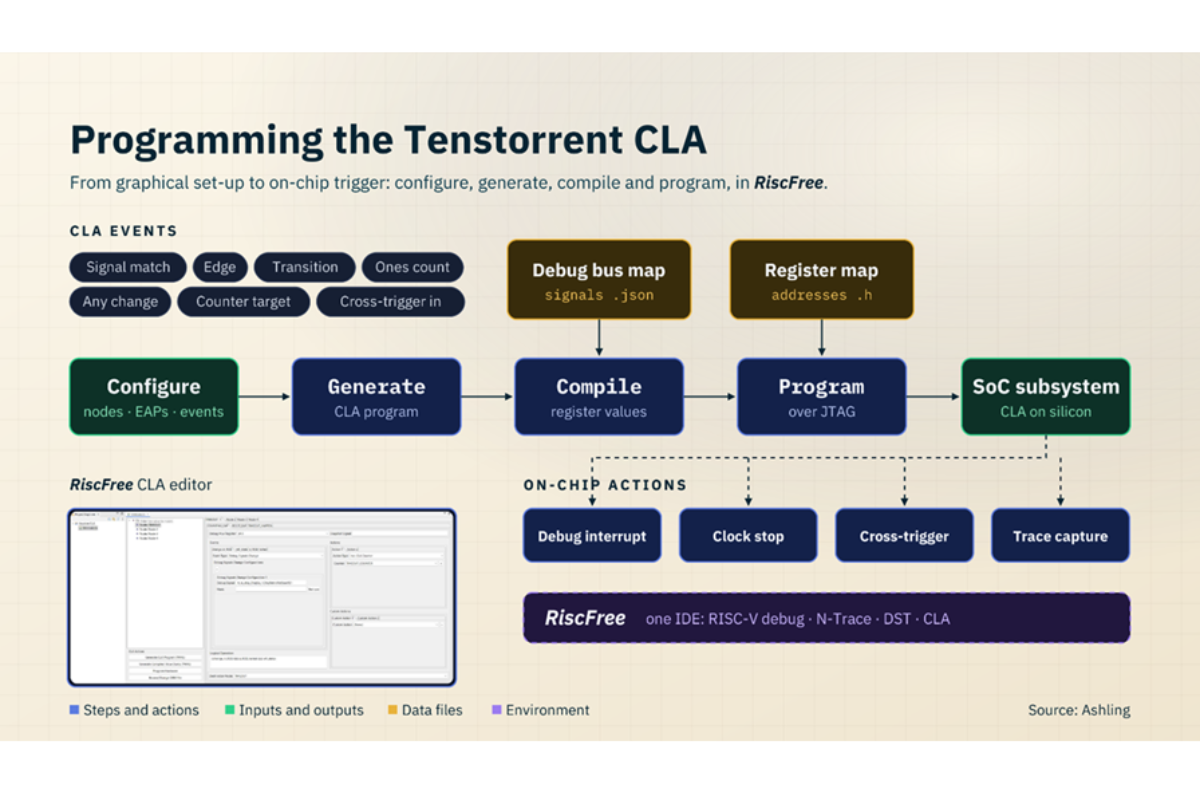
The CLA is the heart of Tenstorrent’s on-chip Design-for-Debug (DFD) infrastructure, documented publicly in its Open Chiplet Atlas Harness (OCAH). It monitors a configurable debug bus, evaluates programmable events such as signal matches, edges, transitions and counter thresholds, and triggers actions including a debug interrupt, clock stop, cross-trigger to other debug blocks or trace capture. These operations happen on chip, without external instrumentation.
Typical uses include catching hangs and timeouts, stopping clocks for state analysis, and measuring the interval between events with the CLA’s built-in counters. RiscFree supports CLA programming alongside standard RISC-V debug, N-Trace and Debug Signal Trace (DST) on Tenstorrent IP cores.

Hugh O’Keeffe, CEO of Ashling, said RiscFree makes CLA setup less manual and error-prone and places it alongside standard RISC-V debug and trace in one tool.
CLA support is available in RiscFree SDK v26.3.0 or greater. More information is available at www.ashling.com/riscfree/.