
Electrical signal is laziest when it want move from 1 to 0 and vice-versa compared to optical signal. So is emergence of photonics to connect between chips as well chip itself using photons instead of electronics to process data. Very challenging and most valuable research in today's world of AI processors. Let's looks into one of the functional blocks in silicon photonics called Reconfigurable Optical Add-Drop Multiplexers (ROADMS). Here is brief introduction to ROADMS:
ROADMs, or Reconfigurable Optical Add-Drop Multiplexers, are critical components in optical communication systems, including those leveraging silicon photonics. In general, a ROADM is a device used in wavelength-division multiplexing (WDM) networks to dynamically add, drop, or pass through specific wavelengths of light (carrying data) without needing to convert the optical signals to electrical ones. This flexibility is key for modern fiber-optic networks, enabling efficient routing of data traffic.
Each line side of a traditional ROADM may handle an optical signal with several wavelengths. A wavelength selective switch is used to either drop and add new signals (add and drop) or split the various wavelengths of the signals and direct them to one of the other line sides (express). With more sophisticated ROADM technology, including spatial division multiplexing ROADMs, wavelength switching can be accomplished by switching spatial channels. In this situation, a suitable spatial switching device, like a "core selective switch" when using multi-core fibers, may be used in place of the wavelength selective switch.
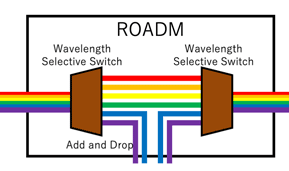
In the context of silicon photonics, ROADMs take advantage of silicon as a platform to integrate optical and electronic functions on a single chip. Silicon photonics uses silicon waveguides and other photonic structures to manipulate light, offering a compact, scalable, and cost-effective alternative to traditional bulk optical components.
How ROADMs Work in Silicon Photonics
Wavelength Selection: A ROADM uses components like microring resonators, arrayed waveguide gratings (AWGs), or Mach-Zehnder interferometers (MZIs) fabricated on a silicon substrate to filter specific wavelengths. These structures can be tuned (e.g., thermally or electrically) to select which wavelengths to drop or add.
Add/Drop Functionality:
Drop: Selected wavelengths are routed to local ports for processing or detection.

Add: New data on specific wavelengths is inserted into the optical network.
Pass-through: Unselected wavelengths continue along the main optical path unaffected.
Reconfigurability: The "reconfigurable" part comes from the ability to adjust the device dynamically, often via integrated heaters or electro-optic effects, allowing network operators to adapt to changing traffic demands without physical hardware changes.
Why Silicon Photonics for ROADMs?
Integration: Silicon photonics allows ROADMs to be co-integrated with electronics (e.g., CMOS circuits), reducing size and power consumption.
Scalability: Silicon fabrication leverages mature semiconductor manufacturing, enabling mass production and lower costs.
Compactness: Waveguides and resonators in silicon are tiny (on the order of micrometers), fitting complex ROADM designs into small chips.
High Bandwidth: Supports dense WDM systems with many wavelength channels, crucial for data centers and telecom.
Applications
ROADMs in silicon photonics are especially valuable in:
Data Centers: For high-speed interconnects and flexible bandwidth allocation.

Telecom Networks: Enabling agile, high-capacity optical backbones.
Emerging Tech: Like quantum communication or 5G/6G infrastructure.
Challenges
Losses: Silicon waveguides can have higher optical losses compared to traditional materials like silica.
Polarization Sensitivity: Silicon photonic devices often need extra design to handle different light polarizations.
Thermal Tuning: Reconfigurability often relies on heating elements, which can increase power use.
In short, ROADMs in silicon photonics bring the power of dynamic optical networking into a compact, integrated platform, driving the future of high-speed communications.