

Engineers and neuroscientists at UC San Diego have developed a soft, wearable patch worn on the fingertip that continuously tracks how much Parkinson's medication is in a patient's system by analyzing their sweat, without needing a battery to run.
The patch monitors levodopa, the standard drug used to manage the loss of motor control caused by Parkinson's disease. Getting the dosage right is difficult: too little levodopa leaves patients unable to move, while too much can trigger severe, uncontrollable jerking movements. Early in the disease, a single dose of the drug can remain effective for several hours, but as Parkinson's progresses, that effective window can shrink to as little as two hours. Right now, doctors largely rely on patients keeping subjective diaries to adjust treatment, a method that often misses dangerous gaps in dosing. This new device offers a way to track real-time levodopa levels in the body continuously instead.
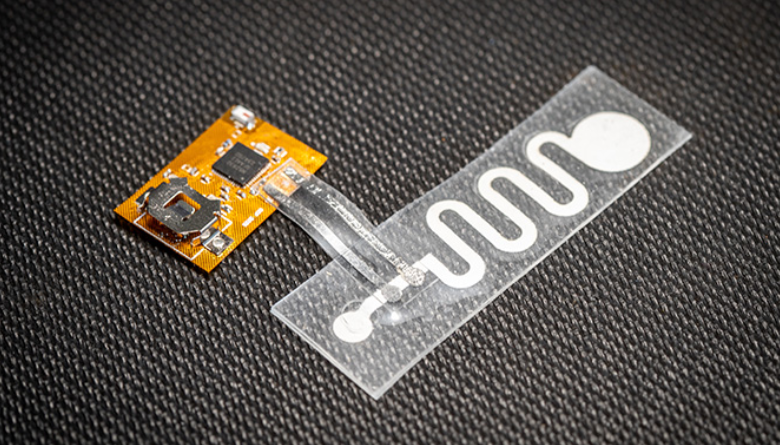
The research, published in Proceedings of the National Academy of Sciences, was led by Tamoghna Saha, a postdoctoral researcher in the lab of Joseph Wang at UC San Diego's Jacobs School of Engineering, working in collaboration with the lab of Irene Litvan in the Department of Neurosciences at UC San Diego's School of Medicine. The two labs have been collaborating for some time on developing wearable levodopa monitors aimed at improving personalized care for people with Parkinson's.
ADVERTISEMENT

The patch is worn on the fingertip, an area of the body with an especially high concentration of sweat glands. It uses a specially engineered absorbent gel that functions like a sponge for sweat, containing a concentrated mixture of salts and mild solvents that pulls sweat out of the skin's pores, since water naturally moves toward areas with higher salt concentration.
When levodopa present in the sweat comes into contact with enzymes built into the patch, it triggers a chemical reaction that generates a small, measurable electrical voltage, which is also what powers the device itself, eliminating the need for a battery. The strength of that voltage also indicates how much levodopa is present: lower voltage corresponds to lower drug levels, while higher voltage indicates higher levels.
ADVERTISEMENT

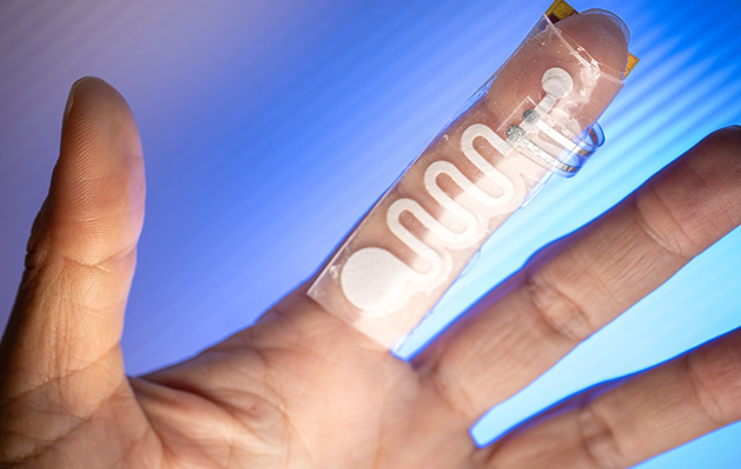
In clinical testing involving both healthy volunteers and people with Parkinson's, the patch tracked levodopa levels about as accurately as standard laboratory blood tests, which typically take days to return results. The data also revealed that people with Parkinson's clear levodopa from their bodies significantly faster than healthy individuals, a finding the researchers say may help explain why Parkinson's symptoms can worsen so suddenly.
The technology lays the groundwork for a closed-loop system in which a levodopa monitoring patch could eventually communicate directly with a drug-delivery pump to automatically administer precise doses exactly when the body needs them. The same research team is also developing a related wearable system that uses microneedles to monitor levodopa continuously, described in a separate paper recently published in ACS Sensors.