
In year 2007 and 2008, one of the most released IC among power ICs is LED driver for high brightness LEDs. The LED based lighting, which is set to overtake al the other lighting options is driving this market. This short article is aimed at helping you in selecting right LED driver.
The White light can be produced by either exclusive white LEDs and through pair of RGB LEDs (getting white light by mixing proportionally the Red, Green and Blue colors). A RGB LED expands the range of visible light in comparison to white LED.
Both white and other high-brightness RGB LEDs perform only at a tightly regulated voltage and current, for any small change in driving current the light output will suffer. Also each LED vendor has different set of parameters prompting design engineer to correct the circuit or change LED Driver.
The forward voltage and forward current are the key parameters to be kept under control to get the max light output. Voltage and current characters may vary even more differently when LEDs are connected serially or parallel. The LED driver should take care of such variations and drive constant voltage and current to produce constant and maximum light. The temperature will naturally change due to heat generated while producing light. Keeping the relationship between voltage, current and temperature for maximum light and enduring and ensuring the life and safety of LED is the task of white LED lighting system design engineer.
LED drivers can be buck type, boost type, buck/boost type, and also charge-pump type.
Depending on the input voltage and output power the choice can be made. For power line driven systems the buck type is chosen, for single cell battery operated devices the boost type is chosen, for the systems which run on both powerline and battery the buck/boost is chosen. Charge pump type is preferred when the output power is less and EMI and other noise are issues.
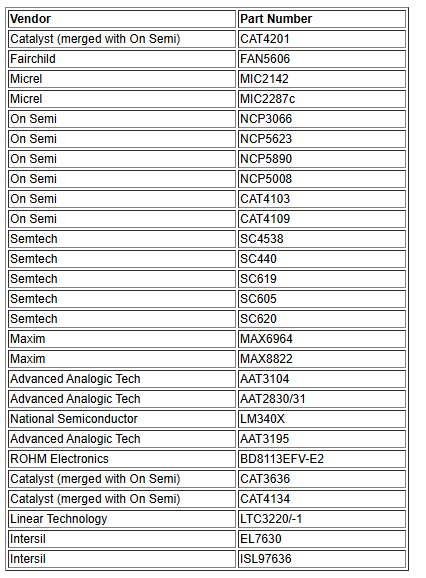
Listed down below are the new LED drivers released recently in the market for you to choose. Please note this list covers leading vendors only and also not ranked by any parameter.

The latest technology feature trends in LED drivers are,
1. To drive LEDs both parallel and series configurations and the capability to drive large number of LEDs
2. Built-in current matching
3. High power efficiencies > 90%
4. Multiple dimming interfaces
5. Low external component count
6. Extreme low current in shutdown mode of less than few micro amps
7. Less space consuming packages such as MLP package, SC-70, TSOT packages.
8. Wide input voltage range
9. Driven by multiple battery chemistries such as Li Ion, NiMH, alkaline, and NiCd
10. Wide operating temperature range from -40°C to +125°C
11. Protection features such as over-temperature protection, over-voltage protection, short circuit and open circuit protection and detection (string and individual), Under-voltage lockout (UVLO), Thermal shutdown.
12. The tight output voltage and current tolerance to keep color and brightness of LED constant.
13. Automatically matching current to LEDs
14. Soft-start to reduce in-rush current
15. Wide current setting range - 31.25µA to 25mA
16. I2C interface to digitally control brightness and color
17. Inductor less feature in case of charge pumps
LED Driver IC list
Few popular LED Manufacturers
1. Toshiba
2. American Bright
3. Cree, Inc.
4. Everlight
5. Lite-On, Inc.
6. Nichia Corporation
7. OSRAM Opto Semiconductors
8. Philips Lumileds
9. Seoul Semiconductor
10. Vishay
11. Avago Technologies
12. Panasonic
To read similiar article on HB white LEDs read "Brightest White LEDs in the market".