

Mastering noise and linearity in Analog IC design: principles, techniques, and future trends
Analog integrated circuits form the backbone of countless electronic systems, serving as the essential interface between the physical world and digital processing systems. From precision sensors that detect the minutest environmental changes to high-fidelity audio equipment that reproduces sound with remarkable clarity, analog circuits enable the sophisticated functionality we rely on daily. However, these circuits face two fundamental challenges that can severely compromise their performance: noise and nonlinearity. These phenomena represent perhaps the most critical obstacles in analog IC design, demanding exceptional engineering expertise to overcome.
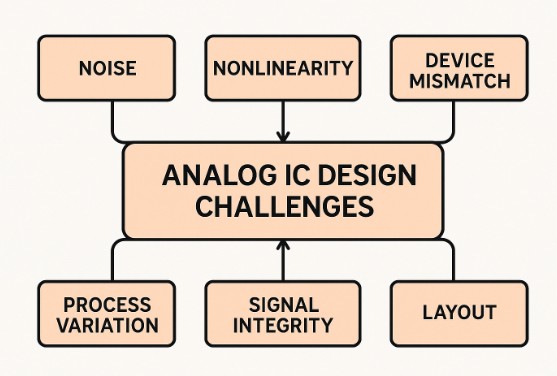
Unlike digital systems that can tolerate some distortion through error correction mechanisms, analog circuits require exceptional signal purity for accurate operation. Even minimal noise can cascade into significant performance degradation, making noise and linearity optimization essential for robust analog design. The challenge is particularly acute because analog signals are inherently vulnerable to various forms of interference and distortion as they propagate through circuit elements.
The Fundamental Nature of the Challenge
The complexity of analog design stems from its continuous-...