

UB-Led Study Enhances Visible Light Absorption in Chiral Semiconductors
A research team at University at Buffalo has developed a method to improve visible light absorption in chiral semiconductors, materials whose structures are left- or right-handed similar to many biological molecules. In a study published in Nature Communications, researchers combined a chiral semiconducting perovskite material with a non-chiral dopant molecule, F4TCNQ, which readily absorbs visible light. The resulting material system absorbs visible light while retaining the ability to distinguish between left- and right-circularly polarized light waves.
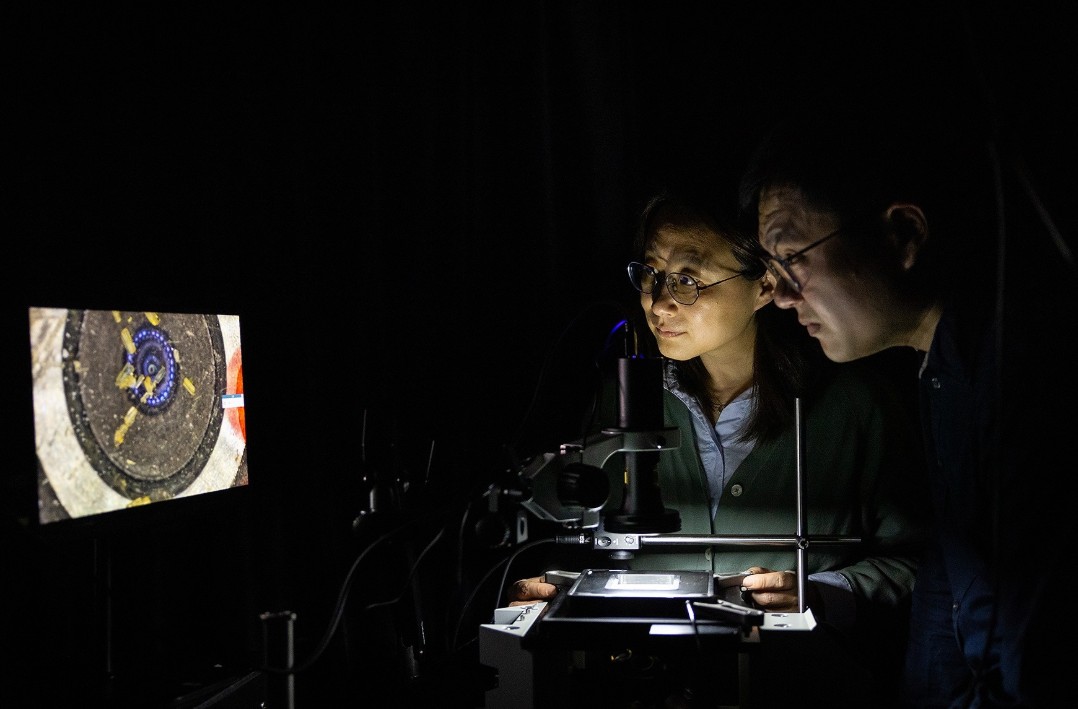
Image: Wanyi Nie, associate professor of physics, and Dave Tsai, assistant professor of chemical and biological engineering
Source: University at Buffalo
Wanyi Nie, associate professor of physics, and Dave Tsai, assistant professor of chemical and biological engineering, use a home-built optical microscope to probe the chiral properties of chiral perovskite crystals.
“We were able to transfer the properties of chirality to a non-chiral molecule,” said Wanyi Nie, PhD, associate professor in the UB Department of Physics and the study’s corresponding author. “The resulting material retains the handedness that makes chiral semiconductors promising bu...