
Panasonic Automotive Systems announced industry-wide endorsement for its initiative to standardize and promote VirtIO, an open-source device virtualization technology, for automotive applications.
Endorsing companies include Honda Motor Co., Ltd., Mazda Motor Corporation, Mitsubishi Motors Corporation, Nissan Motor Co., Ltd., Toyota Motor Corporation, as well as IT and related sector companies such as Amazon Web Services Japan G.K., AMD, Arm, Automotive Grade Linux, Eclipse Foundation, Google, MediaTek, Qualcomm Technologies, Renesas Electronics Corporation, Telechips Inc., and Xen Project.
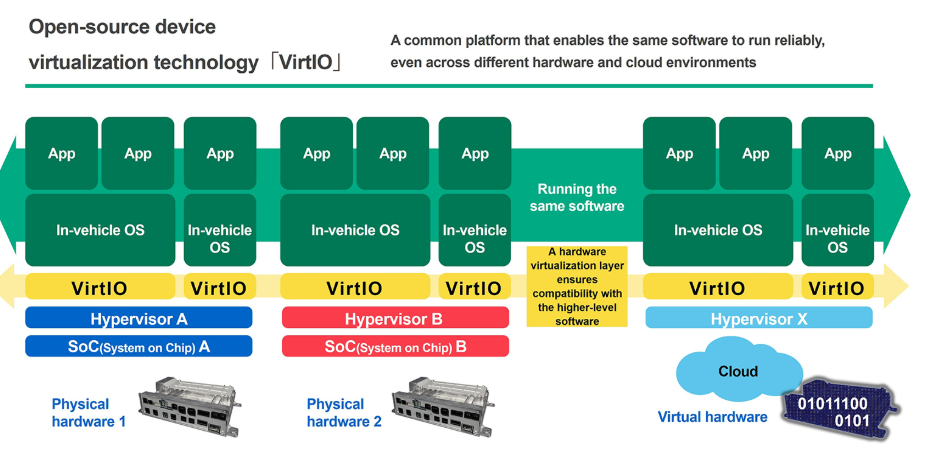
Panasonic Automotive Systems has completed development of a VirtIO-compliant in-vehicle software platform for Cockpit Domain Controller (CDC). The company has promoted VirtIO globally since 2018, engaging the automotive, IT, and semiconductor industries through groups including AGL, Android, OASIS, and SOAFEE.
VirtIO enables device virtualization, allowing creation of virtual hardware environments on computing platforms such as cloud servers. This supports software development and evolution before physical vehicle hardware availability, accelerating development speed and time to market in the Software-Defined Vehicle (SDV) era.
The initiative aims to establish VirtIO as an industry standard to create an open ecosystem where manufacturers can select optimal hardware technologies independently. Panasonic Automotive Systems has also developed vSkipGen, a VirtIO-compliant virtual hardware solution used in its own SDV development and offered to external partners.
Masashige Mizuyama, Representative Director, Executive Vice President, and Chief Technology Officer (CTO) of Panasonic Automotive Systems, stated: “To drive innovation in automotive development in the SDV era, it is essential for companies to adopt VirtIO and develop their in-vehicle software assets in compliance with VirtIO. In addition to software platforms, we have developed vSkipGen—a VirtIO-compliant virtual hardware solution—which is used in our own SDV development and is also available to external partners. We encourage automakers, as well as companies involved in the development of in-vehicle software and components, to endorse this initiative and ensure that their products comply with VirtIO standards, thereby contributing to the global growth of the ecosystem.”
Endorsement comments from the supporting companies highlight VirtIO's role in enabling hardware-agnostic architectures, accelerating SDV development, improving software portability across platforms, supporting cloud-based verification, and fostering ecosystem interoperability in the transition to software-defined vehicles.