

Japan's Semiconductor Dominance and Its Emerging Partnership with India
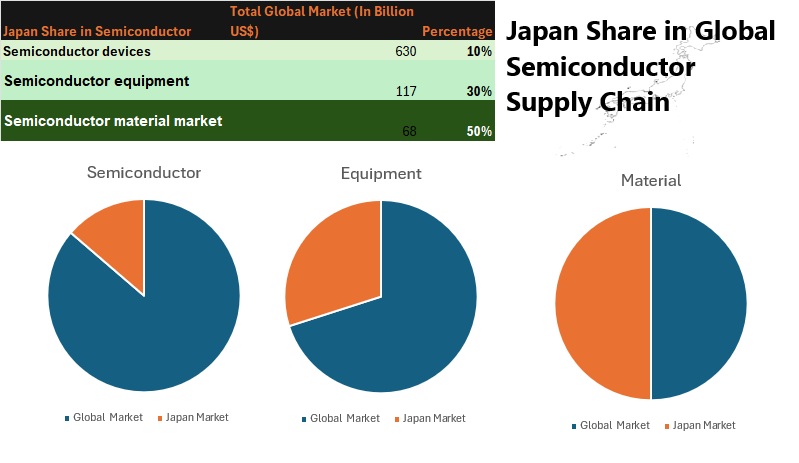
In the 1980s and 90s, Japan dominated the global semiconductor market, commanding nearly 50% of the share, leading in DRAM, memory chips, and automotive applications, with companies like Toshiba, Fujitsu, Hitachi, Mistsubishi, and NEC leading the charge. However, the rise of South Korean giants like Samsung and Hynix, coupled with Taiwan’s TSMC and geopolitical shifts, reduced Japan’s share to approximately 10% by 2024, driven by firms like Kioxia, Renesas, Sony, and Rohm. Despite this decline, Japan retains a technological edge, holding about 30% of the global semiconductor manufacturing equipment market and 50% of key materials, such as photoresists and photomasks, critical for chip production. Post-COVID supply chain disruptions underscored the need for semiconductor sovereignty, prompting Japan to revitalize its industry through initiatives like Rapidus, a consortium aiming to produce cutting-edge 2nm chips by 2027 in collaboration with IBM and Belgium’s IMEC.
India, a nation with a rich history of scientific ambition since independence, faced challenges in scaling its semiconductor industry despite early efforts in the 1970s. Strategic missteps and a post-1990s focus on services over manufacturing left India importing nearly 100% of its chips,...
- Deep-technical articles & analysis
- New-product comparisons
- Premium online courses
- 1 author article / year