

Yole Group has released its inaugural "Status of the RF Industry" report, projecting the global RF semiconductor market to grow from $51.3 billion in 2024 to $69.7 billion by 2030, with a compound annual growth rate of approximately 4.5%. The growth is driven by advancements in 5G, emerging 6G technologies, and increasing consumer connectivity demands.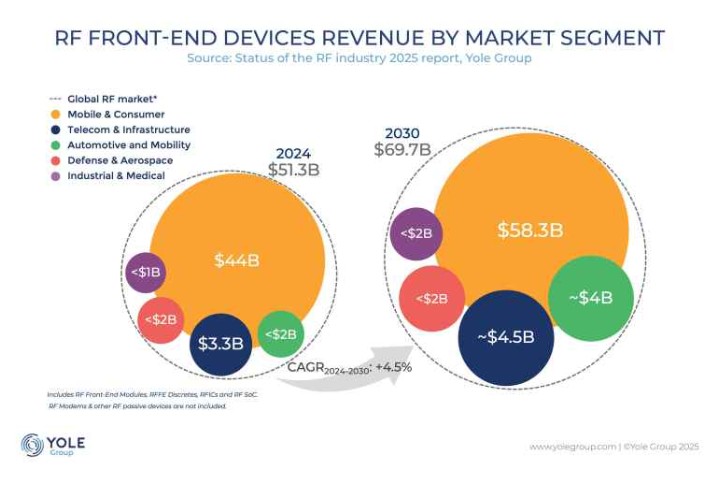
The report highlights the dominance of the mobile and consumer segments, with U.S. companies like Qualcomm, Broadcom, Skyworks, and Qorvo leading in RF front-end (RFFE) modules and system-on-chip (SoC) solutions. Meanwhile, Chinese firms such as Maxscend, Vanchip, Smarter Micro, and HiSilicon are expanding domestic supply chains to reduce reliance on foreign technology. Key subsegments expected to see significant growth by 2030 include RFFE modules ($17 billion), RF SoCs for cellular, Wi-Fi, Bluetooth, and GNSS ($23 billion), and discrete RF devices like power amplifiers, low-noise amplifiers, switches, and filters ($14 billion). Filters, particularly surface acoustic wave (SAW) technologies, are noted as the most dynamic segment, with high-performance SAW gaining traction below 3.5 GHz due to cost and performance advantages over FBAR and SMR BAW technologies.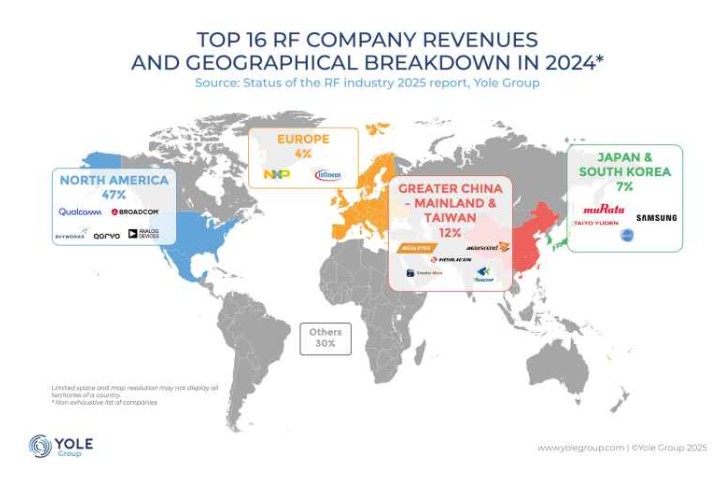

In telecom infrastructure, gallium nitride (GaN) is increasingly replacing LDMOS in massive MIMO base stations, with global players like NXP, Qorvo, SEDI, and Analog Devices at the forefront. China is advancing its GaN and LDMOS production through companies like Sanan IC, Wuatek, and Dynax, spurred by government-backed 6G initiatives. The race for 6G leadership involves the U.S., China, Japan, South Korea, and Europe, each prioritizing RF sovereignty.
The automotive sector is also a growing RF market, driven by advanced driver-assistance systems (ADAS), Wi-Fi, GNSS, and ultra-wideband (UWB) technologies. NXP and Infineon lead with silicon-germanium (SiGe), gallium arsenide (GaAs), and CMOS-based radar ICs, while UWB adoption expands in smartphones, smart homes, and vehicles, led by Apple, Qorvo, and NXP. In defense, GaN-based designs dominate radar, satellite communications, and electronic warfare systems, while industrial and medical applications emphasize reliability and low power despite lengthy certification processes.
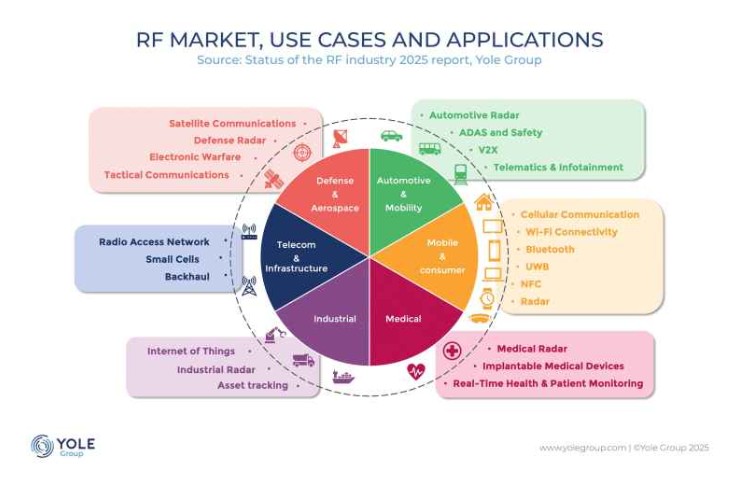
The report underscores RF technology’s critical role across mobile, telecom, automotive, defense, and industrial applications, with integration and performance driving innovation. Yole Group will present further insights at the European Microwave Week (EuMW) 2025, including a dedicated session on automotive radar markets and technologies on September 23.