
AI EDA: QiMeng System introduced for fully automated semiconductor processor chip design
Processor chip design is a critical driver of advancements in computer science and related fields. A new system, QiMeng, has been proposed to address the challenges of semiconductor processor chip design through full automation of hardware and software processes. The system aims to tackle three primary limitations in current design methodologies: physical constraints of fabrication technologies, high resource demands, and the need for diverse ecosystem support.
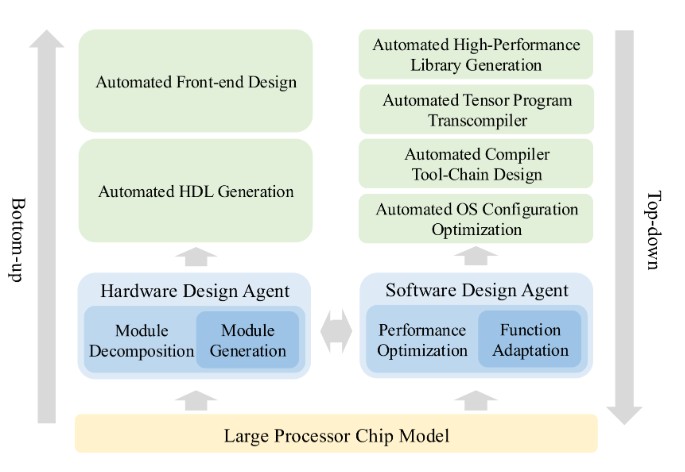
QiMeng, developed by team of engineers, AI specialists and chip design researchers at the Chinese Academy of Sciences is structured in three hierarchical layers. The bottom layer features a Large Processor Chip Model (LPCM), a domain-specific large language model tailored for processor chip design. The LPCM incorporates a multi-modal architecture to handle graph-based data, such as abstract syntax trees and data flow diagrams, addressing the knowledge representation gap. It employs cross-stage collaborative training to mitigate data scarcity by generating aligned data across design stages, from high-level software to physical layouts. During inference, the LPCM uses feedback-driven mechanisms to ensure functional correctness and optimize performance, tackling challenges like correctness assurance and the vast solution sp...
- Deep-technical articles & analysis
- New-product comparisons
- Premium online courses
- 1 author article / year