
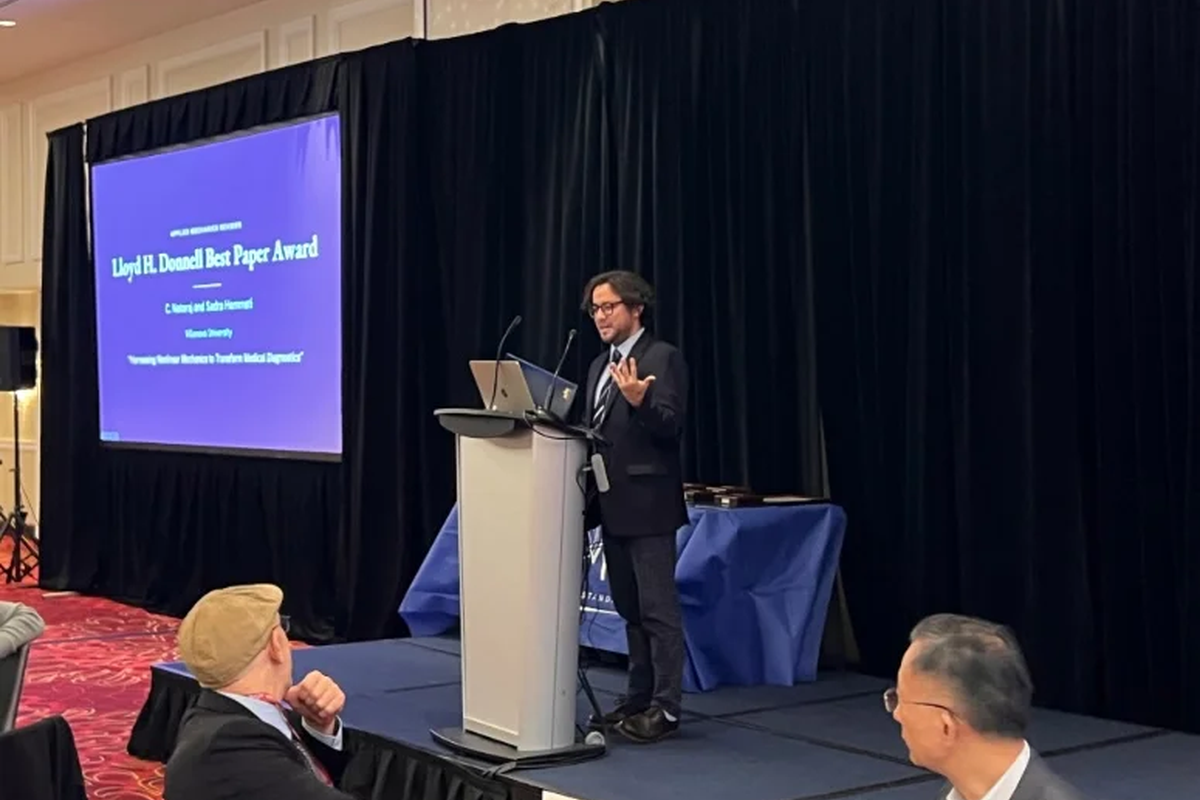
Rice University researcher Raudel Avila co-authored a paper on bioresorbable electronics for temporary medical devices that earned a 2026 award. The Journal of Applied Mechanics Award from the American Society of Mechanical Engineers recognizes outstanding work by early-career researchers.
The paper, written with Rice mechanical engineering students Pei Liu, Chihtong Lee and Nicole Carusetta, examines devices designed to function for a predetermined period before dissolving through natural physical and chemical processes. Depending on their purpose, the electronics can be designed to operate for days, weeks or longer.

A central challenge is keeping a device reliable as its materials interact with surrounding fluids and tissues and its mechanical properties change. Those changes can affect how it responds, maintains contact with tissue or transmits electrical signals. Deformation, temperature, acidity, water exposure and material composition can influence how quickly the device degrades.
Avila studies transient mechanics, or how a material’s mechanical properties evolve throughout its lifetime. The paper highlights computational modeling as a way to predict how materials respond to mechanical forces and chemical reactions as they dissolve, and how a device gradually loses structural integrity.

“We’re accustomed to thinking about electronics as things that should last as long as possible,” Avila said. “But in medicine, there are situations where the most useful device is one that performs a specific function and then disappears. The challenge is understanding how to engineer that entire process, from operation that is reliable to degradation that is safe and controlled.”
Potential applications include nerve stimulation, drug delivery, wound healing and physiological monitoring, as well as flexible devices that wrap around nerves, sensors that track tissue changes and implants that gradually transfer mechanical loads to healing bone. The paper also discusses sustainable environmental sensing, including precision agriculture. Avila identifies the need for more sophisticated models of how multiple materials degrade under physiological conditions and experiments that capture how those changes affect device performance.