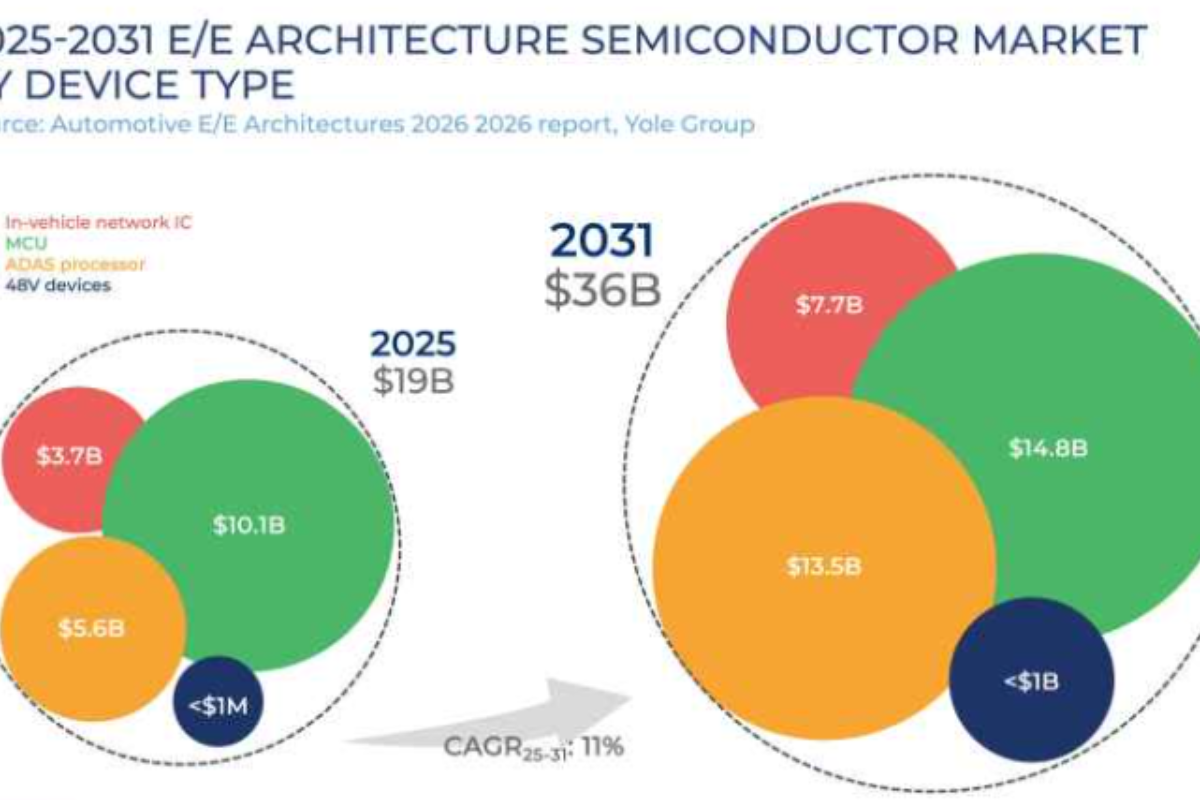
Yole Group has released its Automotive E/E Architectures 2026 report, examining the transition in vehicle electrical and electronic (E/E) systems. The market for E/E architecture semiconductors is projected to expand to $36 billion by 2031. Domain and zonal architecture segments are expected to account for roughly 74% of global semiconductor production by 2031, an increase of about 70 percentage points since 2021.
Last month, Yole Group forecast a $160 billion automotive semiconductor market by 2031, with a 31% compound annual growth rate between 2025 and 2031, according to its Automotive Semiconductor Trends 2026 report. Growth is driven by the number of chips per car rather than higher-value content. Rebuilding the car’s E/E architecture is one of the main factors increasing demand for new silicon.
The new report focuses on the shift from more than 100 scattered control units to a smaller number of domain, zonal, and central computers. It also covers the rise of the software-defined vehicle (SDV) and the processors, network chips, and power devices involved.
For years, the wiring harness ranked among the heaviest and most expensive subsystems, with vehicles carrying over 100 function-specific electronic control units (ECUs) and kilometers of cable. Carmakers are consolidating these into fewer high-performance domain, central, and zonal controllers. This change is driven by the SDV, the growth of advanced driver-assistance systems (ADAS) and AI, and efforts to reduce cost and weight.

Examples include Tesla reducing the wiring in the Model 3 to half that of the Model S, Rivian cutting its ECU count from 17 to 7, and BMW’s Neue Klasse saving around 600 meters of cable while replacing up to 150 fuses with smart eFuses.
Pierrick Boulay, Principal Analyst for Automotive Semiconductors at Yole Group, stated: “This E/EA transition is creating new demand across the automotive semiconductor stack: advanced processors for central AI-based computation ($5.6B to $15.3B, 16% CAGR), high-performance MCUs for domain and zonal controllers (6.6% CAGR), in-vehicle network ICs as CAN/LIN give way to CAN FD and Ethernet (doubling from $3.9B to $8.1B), and a nearly new category of PMICs for 48V powernets (173% CAGR).”
The report tracks light vehicles from 2021 to 2031 and covers the move from distributed to domain, zonal, and central designs, including one-box, one-board, and one-chip integration. Chinese OEMs are projected to reach 56% zonal production by 2031, compared with 18% outside China.
Yu Yang, Principal Lead Analyst for Automotive & Robotics at Yole Group, noted: “In the long-term trend of centralized E/E architectures, we are in the phase of upgrading backbone networks from domain-based to cross-domain zonal architectures plus a central computer for ADAS, infotainment, and vehicle control. Many new technologies are on the horizon, creating new opportunities for semiconductor devices: eFuses, 48V powernet, optical communication, etc.”

Key network and power changes include Ethernet becoming the backbone, CAN evolving, FlexRay and MOST retiring, SerDes replacing LVDS, and the shift from 12V to 48V arriving with zonal architectures and eFuse. OEMs are taking more direct control, Chinese companies are increasing their presence, and memory is identified as the primary constraint.
The semiconductor landscape covered includes automotive processors and the RISC-V ecosystem, microcontrollers, network chips, and power management ICs. The report examines how OEMs and Tier-1 suppliers source silicon through make, buy, or partner approaches. Full in-house design remains limited to high-volume players such as Tesla and a small number of Chinese OEMs.
The Automotive E/E Architectures 2026 report forms part of Yole Group’s automotive reports and teardowns. It maps the redesign of wiring, controllers, and chips, identifies Ethernet, high-performance system-on-chips (SoCs), 48V systems, and eFuses among the technologies gaining ground, and outlines the evolving balance between established Western suppliers and the Chinese ecosystem, based on forecasts, supplier analysis, and teardown work through 2031.