

CeNSE at IISc Outlines Infifab Vision to Address Lab-to-Fab Gap in Semiconductor Development
Professor Ambarish Ghosh, Chair of the Centre for Nanoscience and Engineering (CeNSE) at IISc Bengaluru, presented the centre's achievements and future plans during the inaugural session of COSEIN 2026 and by his own admission, had a specific agenda: "I want to focus the last 30% of my talk on what lies ahead."
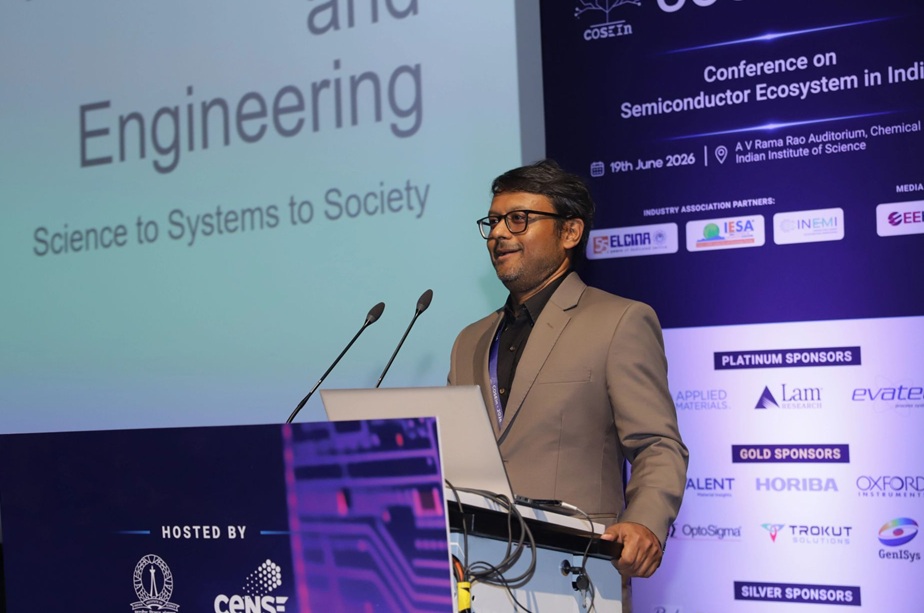
Ghosh described CeNSE's evolution from its formal establishment in 2010, building on earlier nano-electronics initiatives dating to 1998 under the vision of R. Chidambaram, then Principal Scientific Adviser. The first five years, he said, were spent simply building and opening facilities. From around 2015, rapid expansion began in faculty, students, and technical staff, alongside closer industry and strategic sector engagement. By around 2020–2025, CeNSE had made its first serious foray into the gallium nitride foundry, what Ghosh described as "truly making that full research go into society through our system."
Research has since broadened from what Ghosh characterised as "electrons and photons" to include "molecules and qubits," spanning 2D materials, wide-bandgap semiconductors, thin films, photonics, MEMS/NEMS, nanobiomedicine, quantum technologies, and computing approaches including neuromorphic and chaos-based systems.
Key metrics included hig...